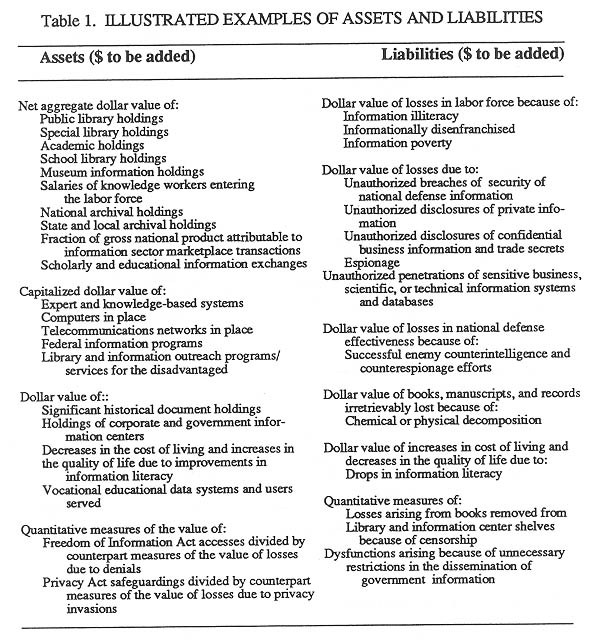
Table 1. ILLUSTRATED EXAMPLES OF ASSETS AND LIABILITIES
Chaired by:Peter Young
Exective Director
U.S. National Commission on Libraries and Information
Science
Washington, D.C. 20005, USA
py_nclis@inet.ed.gov
INTRODUCTION
This is a panel on NII and GII -- Government and
Industry's Roles. We have two speakers. The first speaker is, I think,
familiar to a lot of people here, if not a lot of people around the world
-- Woody Horton, Vice President of the International Federation for Information
and Documentation (FID). He has been active in information services and
sciences for a long time. I don't want to mention his exact age, but I
do want to mention that Woody is the proud grandfather of two new grandsons
born, I think, in the past year, or within the past 6 months. Woody's career
is a very distinguished one. In addition to being Vice President of FID,
Woody also was the Staff Director of the Commission on Federal Paperwork.
I also designate him as father of information resources management (IRM).
Woody's topic this morning is "Viewpoint: A business format for the national
information infrastructure."
4_______________________
PANEL ON
NII AND GII - GOVERNMENT AND INDUSTRY'S ROLES
VIEWPOINT:
A BUSINESS FORMAT FOR THE
NATIONAL INFORMATION INFRASTRUCTURE*
+
Forest Woody Horton, Jr.
Vice President, FID
Washington, D.C. 20037, USA
woody@cni.org
It is ironic that at a time when there is a superabundance of information attending the emergence of the computer age, more and more businesses, institutions, and individuals are unaware of the information that is needed to cope efficiently with the daily array of family, job, financial, and other crises and challenges.
Of those who are aware of how to cope with these challenges, more often than not they do not know what specific information resources are available to them, where they are located, what their relative benefits and costs are, or how these resources can be efficiently accessed. Even if they have the know-how to find this vital intelligence, often they have neither the time nor the financial means to obtain it.
In short, an increasing faction of the American population and its businesses, as well as institutional sectors, are becoming increasingly disadvantaged in ways that interfere with their ability to make use of this country's vast national library and information resources: financially because of functional literacy deficien-cies; geographically because of remoteness; or for other reasons. It would appear that the electronic era is increasing the division between the "information haves" and the Information have nots."
Whose responsibility is it to educate and train people to use libraries and in-formation resources? The burden has fallen largely on the nation's educational system. Although they have always played a central role in the educational system at all levels and in many employment situations, libraries are increasingly at risk of losing the tough battle in the competition for budgetary dollars being fought in the halls of Congress, federal agencies, state capitals, school districts, academia, county seats, municipalities, and corporate boardrooms.
Lack of experience in budget battles
There are many reasons why the situation is grave and becoming worse. One is that librarians and information services managers traditionally have taken it for granted that they will be protected from the budget ax because they occupy a very special and coveted niche in society and are thus above the field of battle. Historically it has not been necessary to develop the political and corporate in-fighting skills that their less fortunate brethren in other professions and organiza-tions have had to acquire.
Growth of the information industry
Another reason is that t he information age is bringing with it profound changes in the library and information marketplace. A whole new industry, the informa-tion industry, is competing against libraries for public and private dollars. This rich, powerful, and eloquent industry is composed of Fortune 500 publishers, online distributors, database providers, information brokers, and many other kinds of companies in which employees are trained in business practices such as marketing, advertising, litigation, and other areas unfamiliar to the library.
Loss of priority in government spending
A third reason is that in the Gramm-Rudman era of enormous federal, and often state and local government, deficits (coupled with an aggressive administration strategy to privatize government information programs and services, including libraries, and to charge user fees for many kinds of services that were once free to citizens), hard-nosed politicians and business people do not view libraries and information services as high-priority line items.
There are other reasons. But the central point is that this reticence on the part of the broader library community to present itself in the "bottom-line language" understood by public officials, corporate officers, and institutional administrators (in the budgetary decision forums in companies, government agencies, universi-ties, schools, hospitals, and associations) must change if libraries and the broader American knowledge community are to survive the continued erosion of top-level support.
NEED FOR BETTER COMMUNICATION
The library and information services community needs to communicate more aggressively its message to its various constituencies. One such approach would be to use the style and format of the corporate annual report (see Figure 1).
_________________________________________________________________
Figure 1
_________________________________________________________________
SUGGESTED COVER FORMAT FOR ANNUAL REPORT OF THE LIBRARY AND INFORMATION SERVICES COMMUNITY
_________________________________________________________________
LIBRARIES HELPING AMERICA WORK SMARTER
FIRST ANNUAL REPORT
on the state of the
NATIONAL LIBRARY AND KNOWLEDGE INFRASTRUCTURE
1987
prepared by
The National Commission on Libraries and Information
Science, Washington, D.C.
with the assistance of
Members of the Library Community, the Information
Community and the Knowledge Community
_________________________________________________________________
Individual corporations such as AT&T Bell Laboratories have been experi-menting with an annual-report approach for some years. The National Commis-sion on Libraries and Information Science may wish to consider using a similar type of format for the U.S. national knowledge resources infrastructure, not only nationally but as a model for other libraries to tailor to their specific needs.
Such an annual report, the first of its kind at the national level, would be an attempt by the National Commission to establish, explain, and defend the benefits and the costs, the assets and the liabilities, and the profits and the losses of the "national library and knowledge resource," taken in the aggregate and presented in an business format context.
The following could be the message of the report: "Libraries and information services are indispensable assets to the nation and its institutions, private and public, not just in the traditional social, scientific and academic contexts of edu-cation, scholarly research, recreation, citizenship development, and personal self-enrichment, but in the economic, business, and industrial contexts that are of crucial importance to the country today. These national challenges include in-creasing industrial productivity, improving America's ability to compete abroad, helping companies to produce and market better products for domestic consump-tion, and, in general, 'helping America work smarter.'"
Some people may be shocked or at least disquieted that any attempt should be made to quantify and measure something as intangible and qualitative as the value of library holdings and information services. Whereas some may sympa-thize with the sentiment, others may be dismayed that libraries should have to stoop so low to achieve their goals. I disagree with the latter sentiment and hope that the National Commission will be convinces that the times demand unusual and even extraordinary measures.
Although the approach suggested here is primarily illustrative and undoubted-ly would need to be refined and improved, it is hoped that the first such annual report would at least communicate a message of critical importance to the nation more persuasively and articulately than more conventional formats and language. Such a format would not replace existing methods of presenting and defending library and information services budgets but would supplement conventional techniques.
THE NATIONAL LIBRARY AND INFORMATION INFRASTRUCTURE
The annual report might begin with a discussion of the national library and infor-mation infrastructure. This introductory section would be analogous to a short descriptive profile that typically prefaces the "facts and figures" sections in com-pany annual reports; it is a sort of brief, context-setting background or overview. Instead of describing what "the company" is–its position in an industry, its markets and products, and its roots and evolution–the report would describe the "enterprise": in this case, the national library and information infrastructure.
Definition of infrastructure
Just what is an "infrastructure"? This is not an easy concept to explain, and it could raise the question of how there can be an annual report for an infrastruc-ture. At the national level, the State of the Union Message and the Annual Eco-nomic Report to the Nation are perhaps rough examples of analogous presenta-tions that mix rhetoric with facts and figures.
Infrastructure refers to the underlying foundation or basic framework of an organization or system. In the industrial world it refers to transportation, com-munication, and power grids. Often referred to as social overhead capital, infra-structure also includes railroads, hydroelectric plants (or nuclear generators), and telephone lines, as well as major highways and secondary roads. Within cities on would also include in this concept such major "people movers" as bus lines, sub-ways and streetcar lines, as well as the streets and space they occupy. An out-standing characteristic of most of the infrastructure of a nation's entire industrial economy is that it is designed to move things or people to allow business and social activities to occur.
Building the infrastructure
The following are the kinds of problems that can arise in deciding how much industrial or information infrastructure to build and how complex to make it:
• The capital involved in infrastructures is "lumpy" (i.e., it is not easily divisi-ble) so initial outlays are often rather large compared with those in other forms of investment.
• Governments are usually implicitly or explicitly involved in providing in-frastructure capital because of external economies, large initial outlays, technical indivisibilities, the difficulty of entry for small entrepreneurial firms, and the likelihood of declining costs with increased use. The private sector usually fails to provide the right amount or type of infrastructure.
Broadly speaking, then the national library and information infrastructure con-sists of four parts:
2. Software: Software comprises the information systems and computer pro-grams that enable end users to operate all of the hardware efficiently and effectively by telling it what to do, how to do it, when to do it, and so forth.
3. Supporting physical and human resources: This component is composed of all the physical plant and facilities, the supporting human resources (knowledge workers), and other economic and social capital needed be-yond the hardware and software.
4. Data, information, and knowledge: The fourth component is the actual data, information, and knowledge in whatever media or format: electronic, optical, hard copy; in the form of bits and bytes in computer data banks; in document or archival repositories; or in literature on the shelves in libra-ries.
OPERATION OF THE INFRASTRUCTURE: PRODUCTION AND MARKETING
What makes the information infrastructure productive is its flexibility. That is, it allows a wide variety of information-processing activities to take place at all levels of human activity: on an individual level, in the family and the community; in the context of employment; in industry and government; in other institutional contexts; and at the international level.
In the office, for example, we find the emergence of word processors (stand-alone or communicating); microcomputers; electronic filing systems; local area networks, database management systems; and, through modems, access to exter-nal database services.
The national library and information infrastructure has transformed the tele-phone system from the simple "twisted pair" to a telecommunications system that allows for private automated branch exchanges providing call forwarding, call monitoring, and voice mail. This telecommunications system allows for electro-nic mail–the instant delivery of interoffice mail, memos, documents, and re-ports; it also can allow for video conferencing–remote meetings that include full or partial video link and audio and data transmission. Increasingly, fiber optics is being used as a high-speed link that provides a secure system for transmission. Other features of the new telecommunications system include facsimile trans-mission (the transmission of document copies) and a dedicated satellite system.
The information infrastructure is intimately linked with, and creates the capa-city to use, a variety of computer-based technologies, such as super computers, which are increasingly used for long-term weather forecasting. It allows for the emergence and full use of artificial intelligence, expert systems, voice synthesis and recognition systems, point-of-sale scanning equipment, and electronic funds transfer systems, as well as "smart cards" for retailing and banking.
The modern factory is linked with the information infrastructure to allow for computer-aided design, engineering, and manufacturing; robotics; and automated shop floor data collection systems. In short, the modern factory is one that has computer-integrated manufacturing and employs flexible manufacturing techno-logies.
Whereas the industrial age infrastructure was largely designed to move things, the information age infrastructure will be largely designed to move electrical impulses. The raw material of the information society and the information economy is data. Data are moved in the information age by using the national library and information infrastructure via these electrical impulses. Of course paper probably will not disappear in the foreseeable future.
In the information age, we are increasingly substituting "machine intelligen-ce" for "human intelligence." Without getting into a technical discussion of the nation of intelligence or how to define a machine, it is clear that we are now, have been for some tine, and will continue in the future substituting machines for work that formerly depended on human intelligence on the factory floor, in the office, and in the laboratory.
The service sector is becoming increasingly capital intensive, with the capital that is being used largely consisting of those elements that make up to informa-tion infrastructure. Information is the raw material of the new economy; it is central to manufacturing, services, and government. In industry, the "need to know"–the need to inquire, communicate, evaluate, and make decisions–fuels the search for information on which business decisions are based. As a result, the corporation is slowly evolving into a kind of information-rich, organic learning system that transforms data from various sources into the capital knowledge-base on which the corporation ultimately rests.
It is worth noting that in an information economy, comparative advantage can be a dynamic rather than a static concept. In a manufacturing-dominated econo-my, the assumption has tended to be that the presence or absence of comparative advantage is inherent as a function of geography and access to labor and resource and capital inputs; therefore, trade strategies have been devised accordingly. In an information economy, it may be possible to create comparative advantage by devising strategies to create innovative and attractive packages that provide a combination of various services.
Modern computerized information systems, and the databases on which they are built, also support myriad social, community, and personal needs via elec-tronic information referral services. These services provide coping and support mechanisms to the destitute, hungry, and poor and to other disadvantaged groups. Governments at all levels provide hundreds of health, education, and income security programs designed to assist these disadvantaged groups. Individual programs are customized to the elderly, functionally illiterate, and financially disadvantaged and to pregnant mothers, runaway children, battered wives, and many other target groups.
In sum, there appear to be at least six functional roles that the library and information infrastructure has as an enterprise engine in the information society and economy:
2. Guardian of the public good: monitoring progress, evaluating perfor-mance, and promulgating safe-guarding standards.
3. Facilitator: pursuing private sector-public sector interaction, developing compensatory-complementary services rather than primary provisioning, and promoting interagency partnerships in the delivery of services.
4. Provider of "core" collections and services: coalescing national libraries, and information services programs, and national bibliographic records; "non-commercial" collections; and public sector databanks.
5. Honest broker: bringing relevant parties together, enabling and encourag-ing dialogue between them, and supporting the corporate planning process.
6. Positive discriminator in favor of the disadvantaged: bringing economic, physical, mental, and social dimensions to bear resulting in political debate and choice.
How do we value to nation's vital library and knowledge assets in terms of dol-lars? We are still struggling with finding ways not only to quantify information but also to account for it like any other asset on the company books. Units of measure are still undetermined.
The first step in the process is to decide what we mean by "information" and the determine the role it plays in each of our particular institutional or organiza-tional settings (see above). Accountants recommend both cost-based and apprai-sal-based valuations as possible ways to determine and express quantitatively the value of knowledge assets.
Except for total budgets, sources of revenue, and expenditures in operating budgets, dollar figures are extremely hard to obtain. As a consequence, in this illustrative first annual report, order-of-magnitude estimates probably will have to be used; at the same time a variety of studies to validate these estimates could be undertaken and coordinated by the commission. There can be no question about how substantial the research will need to be to discover appropriate units of measure, study and survey population groups to distill valid data samples, and test the results of such research with the decision makers whom the information community wants to influence.
In a literal sense, then, a portrayal of the first balance sheet and profit and loss statements would be but a beginning–a tentative first step along a very long road. Although there is always the problem of comparing things that are not categorically similar, what is important is that one makes a start; criteria, guide-lines, and refinements to the initial lists can be made later with respect to details such as refining the units of measure and determining the basis for making a valuation.
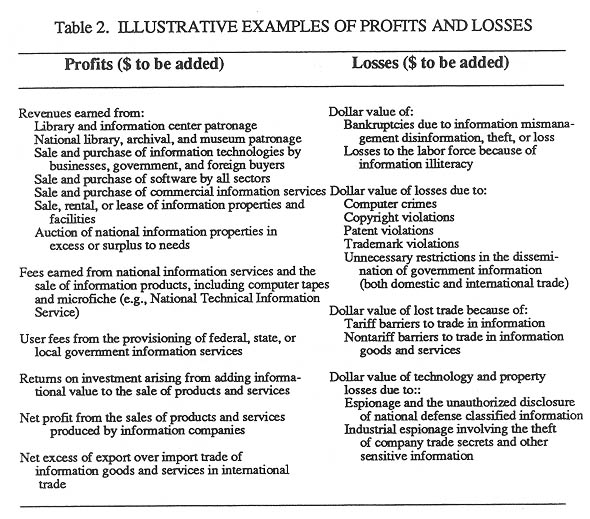
Table 1 illustrates a wide variety of information assets and liabilities. Table 2 suggests some types of information profits and losses, equally diverse in the aggregate. The specific entries under "assets," "liabilities," "profit," and "loss" are merely suggestive and illustrative at this state.
Table 1. ILLUSTRATED EXAMPLES OF ASSETS AND LIABILITIES
FUTURE PLANS, GROWTH AND ANTICIPATED PROBLEMS
As would be indicated in the annual report, the potential for growth and expan-
Table 2. ILLUSTRATIVE EXAMPLES OF PROFITS AND LOSSES
sion of libraries, information services, and, in general, the national library and
knowledge resource infrastructure base may well be tied to the community's ability to visibly and tangibly demonstrate the utility of these services in a variety of public and private sector economic contexts. Problems, both new and old, will require carefully developed plans that will have direct impact and be measurable. The following are some specific initiatives that can be expected to have the type of direct impact that is required.
Networking knowledge resources
The promise of telecommunications has already had a substantial impact on virtually all sectors and at the national, institutional, organizational, and personal levels. Linking the nation's vast data, document, and literature resources poses challenges that go far beyond consortia, interlibrary loans, document delivery, online searching, and automated library services and management. The goal should be no less than the mobilization and harnessing of the holdings and flow of an integrated national information resource system.
Goals need to be translated into objectives, and objectives need to be turned into short-term action plans. Parts of the networking infrastructure are already in place. But they have not been fitted into an overall national information manage-ment schema and architecture.
Upgrading professional status and diversifying career pathways
The stereotypical librarian and information service worker are too well known to require discussion here. Many librarians are scornful of emerging computer age titles such as "knowledge engineer" and "telemarketer." But opportunities for enhancing the professional image of librarians and information service workers depend in no small measure on their becoming diversified enough to fit the occu-pational niches that are emerging from the direct application of modern informa-tion-handling technologies in such places as business offices, factories, labora-tories, classrooms, and medical records departments. Librarians and information professionals must fight to break down these stereotypes that interfere with their entry into the knowledge labor force.
Sitting in the boardrooms of power
Many librarians are reticent about seizing opportunities to wield economic and political power. Behavioral scientists have long studied the conflict in personal values that often arises when information service providers start climbing the organizational ladder. Still, the notion of a chief information officer (CIO) is catching on in both private industry and in the public sector agencies. Since they are candidates with the highest qualifications for the CIO role, more and more librarians and information professionals can expect to be called on the enter the boardrooms of power, not just in the information industry but also in academia, government, and the other sectors.
Reenergizing public policy initiatives
Efforts in Congress to introduce legislation aimed at institutionalizing the "na-tional information policy" concept in the form of study commissions, research agendas, government agency reorganizations, and new laws have all been only marginally successful. Lack of substantial success thus far, however, should not discourage the community's zeal to persist. What is needed is a more carefully thought out and executed strategy that is directly built on the legislative and political agendas of the movement's existing or potential champions and a strate-gy mosaic that includes components for both social and economic roles.
• • • • •
This article has endeavored to make the case for
utilizing a business annual report style and format to present the role
of libraries (both collectively as a national institution and individually
at the organizational level) as vital components of the country's economic
livelihood. If this approach appears to have merit, the National Commission
on Libraries and Information Science may wish, either alone or in a partnership
with other organizations and communities, to give priority to further developing
and refining such a concept as a work project. Since administrators and
corporate officials must make budget choices, it seems that it would be
better if they made those choices on the basis of data formats with which
they were more accustomed.