PANEL ON GLOBAL LIBRARY, CULTURAL AND HERITAGE INFORMATION NETWORK, AND ELECTRONIC INFORMATION SHARING
Chaired by:
Robert M. Hayes
Professor and Dean Emeritus
Graduate School of Library & Information Science
UCLA
Los Angeles, CA 90024
IFX1RMH@mvs.oac.ucla.edu
Introduction
Good morning. Ladies and Gentleman. The agenda for this session has been slightly changed from the published program because of the move of Steinkova's paper to yesterday's session. This session will include Ching-chih Chen's paper as well as an additional paper by Kari Marklund on education.
This session concerns a major theme underlying the value and use of new information technologies and a purpose for creating a global information infrastructure: it is that of making available, preserving, and transmitting a national cultural heritage. A prime example of what can be done is the publication of The First Emperor of China by Ching-chih Chen.
I'd like to take a moment of time to comment on that
production. It is a multimedia package that has received awards, and certainly
is one of the finest examples of what can be done today. I have to say
that Ching-chih Chen did that by herself, not only in terms of the production
of it, but also in terms of the political maneuvering required to get the
agreement of the government of China to allow the photographing and production
of the videodisc and also CD-ROM publications. She did that, I think, with
a grant of about $250,000 from the National Endowment for the Humanities
(NEH). IBM in the last few years has produced an almost equally good product,
called Columbus, which they produced with some 5 million dollars,
5 corporations, and some 50 people, which shows something about the relative
value of IBM and Ching-chih Chen. With that introduction, I now call on
Ching-chih Chen.
7_______________________
PANEL ON GLOBAL LIBRARY, CULTURAL AND HERITAGE INFORMATION NETWORK, AND ELECTRONIC INFORMATION SHARING
INFORMATION SUPERHIGHWAY AND THE DIGITAL GLOBAL LIBRARY: REALITIES AND CHALLENGES*
Ching-chih Chen
Professor & Associate Dean
Graduate School of Library and Information
Science
Simmons College, Boston, MA 02115,
USA
cchen@vmsvax.simmons.edu
Throughout history, libraries have transformed storehouses of treasures and information resources for centuries to dynamic information centers. Yet, the contemporary roles of these libraries will go far beyond these to the "virtual" domain. Each library has potential to be the dynamic and aggressive information provider of existing multimedia information resources, as well as an effective node of global information network which can provide access to all needed global information.
This paper extends the concept of "The Digital Global Library" which Ching-chih Chen has presented in recent years, including her keynote speeches at the 60th Anniversary celebration of the National Central Library of ROC in Taipei, April 1993, and Crimea '94 in Eupatory, Ukraine, May 1994.
In recent months, with all the emphases and highlights on the coming of the so-called "information superhighway," it seems most timely to elaborate on the topic of "the global library" in light of this "superhighway."
Years ago, futurists like Toffler predicted the coming of a shrinking global village, and today, we are experiencing the true meaning of such a shrinking globe. In recent years, I have made several whirlwind trips around the world, and during the last quarter of 1992, I also made two major consulting trips to 9 coun-tries of the Eastern Europe in a total period of one month. I have been privileged to experience personally this shrinking global village, as well as exposed to the world's enormously rich information resources. I could not help not to raise a question of very big order, "How can we begin to share these information globally?"
AN ERA OF UNPRECEDENTED CHANGE
Since the World War II, we have been in an era of unprecedented technological, social and economic changes. These changes have been particularly dramatic in the past decade. Technologically, the advent of microcomputers, optical discs and other mass storage media, worldwide packet networks and communications technology, digital image technology, computer graphic technology, multimedia technologies, compression technology, etc., have dramatically changed the way we live, think, and communicate with each other, and certainly the way we use and view technologies. For example, in the optical technology area, a few years ago, we marveled at the incredible CD-ROM capable of storing 600 MBs of tex-tual information. Now, not only multimedia digital CDs are becoming common place, but the storage capacity has increased immeasurably. For example, a few months ago IBM announced a few months ago its new layered CD which can store 10 times more information. The fast-pace technological developments in these areas, while expected, have surprised many in terms of their widespread scope and intensity.
The new technology buzzwords are everywhere these days, and there is not a single day -- regardless of whether we listen to the news on radio/TV or read newspapers/magazines at home, or traveling by train or air, or listening to the radio in our car -- that we can escape the mention of global village, electronic or digital information superhighway, information age, cyberspace, electronic frontier, etc... In addition, communications satellites, global trade and invest-ment, global technology transfer, and jet travel have prompted dramatic social and economical changes as well. These have pushed the national economies into a more integrated world economy.
UNIVERSAL INFORMATION ACCESS
Viewing this situation from the angle of communications, we have passed several "information jumps" -- from speech to writing to printing, and now to wire and wireless communications. The last makes effective communications possible on a continental scale, and is taking us toward a global civilization. Take Internet as an example, started in 1969 by the US Defense Department with its humble beginning (the US National Science Foundation took over primary responsibility for managing the network in 1986), once exclusively used by American research scientists and computer specialists for e-mail, group discussion and conduct research, has greatly expanded in the last couple of years and is fast becoming the most effective medium for mass communications. Currently, the Internet is really the SUPRANATIONAL global digital information superhighway -- the global communications network, which connects networks of federal, regional, academic, private, and foreign users. It is a network of more than 45,000 net-works that form the world wide web. Its membership doubled in 1993 to more than 15 million users and is expanding faster than any one can predict accurately. Most of us are users of Internet and the benefit of this network is undeniable.
As to the wireless communications, expected to be one of the most important technologies of the next decade, it will be as commonplace as wired one within two to three years. With the appropriate hardware platform and proper communi-cations, network and user interface software, packet radio node can serve as part of an "ad hoc" network of other packet radio nodes. Each packet radio system within the network becomes a de facto member of the "ad hoc" network [Mello, 1993]. In most cases, this network is then connected to the larger wired network such as Internet. Wireless communications are driven by two forces -- the trend to untether computers from the desktop, and the desire for universal connectivity. Normally, the forces of portability and connectivity are at odds, but wireless communications permits one to have the best of both worlds -- freedom from the desktop and connectivity.
Thus, as computing and telecommunications develop and merge, what lies ahead is another jump toward what might be called universal information access. This would mean that anyone, anywhere, could talk, write, confer with, or send both textual and visual information to anyone else in any part of the world. This means that the concept of the digital "Global Library" is not only conceptually sound, but technological feasible now. With this kind of universal library, we would have access to global information resources which include the collections of the world's great libraries.
WHERE IS INFORMATION SUPERHIGHWAY LEADING US TO?
In a major study of the Information Industry Association in 1989, entitled The Information Millennium: Alternative Futures, many major technological changes that may occur during the last decade of this century were identified. Let me list only a few in the following for illustrative purposes:
• 90% of the work now done on mainframes will be done on desktop compu-ters by 2000.
• Optical storage density will increase by a factor of six through data com-pression and other techniques.
• The phone system will be end-to-end digital, capable of carrying text, data, graphics, pictures, and full-motion video, as well as voice.
• Fiber optics will be the dominant transmission mode for most fixed applica-tions, and fiber transmission into homes will be beginning.
SHIFT TOWARD A LEARNING-ORIENTED SOCIETY: THE NEW EMPHASES
With all the unprecedented changes, it should not be surprising that there is an increasing demand for better access to necessary global information which can enable us to have a bigger picture on the world in which we are living in, a better global view on our environment, our history, our cultures, our economy, our science and technology, etc. Thus, information, has become the key to produc-tivity, and there is a shift toward a knowledge-based learning-oriented "creative society." In this type of society, we are witnessing the following change in emphasis:
• Societal values change from "acquiring" to "learning"
• Growing motivation of individuals for knowledge
• More people learn to use information creatively
• More demand for multimedia information
• More demand for global information
It is clear then that a changing society characterized by continuing technologi-cal progress, societal and economic changes will definitely pose new challenges to libraries. It demands our libraries to transcend traditional methods of provid-ing information access within the confines of library's physical structures to providing access to services and global information resources to people at home, in school, at work, or any place so desired by them.
THE CONTEMPORARY ROLE OF LIBRARIES
What is the changing role of libraries in this new information age then? In 1986 when I discussed the current day's libraries in the midst of a period of unprece-dented change and adjustment, I advocated the need for libraries to shift focus in order to include the following directions in addition to our basic functions [Chen, 1986]:
• From the library as an institution to the library as an information provider, and the librarians as a skilled information specialist functioning in an all-related information environments.
• From using new technology for the automation of library functions to utili-zing technology for the enhancement of information access and delivery not physically contained within the four walls of the library.
• From library networking for information provision to area networking for all types of information source providers.
• From information access to selectivity of the most relevant
• From centralized information systems to distributed information systems
• From national networks to a global "network of networks"
• From a focus on libraries being the warehouses of library materials to focus on the "content"
• From technology that supports the library staff to technology that empowers the library user
• From the adaptation of individual technology utilization to technology integration in libraries.
Up to now, unquestionably, for centuries, all national libraries in the world have been store houses of their countries' treasures and rich information resources, and all major academic/research libraries have attempted to boast of their resources judged by the volume and/or size of their collections. Quality of library and information services has seemed to be closely correlated with the quantity of available print-based information resources. But, the contemporary roles of libraries have to go far beyond those of the "storage" houses. Each library needs to be the dynamic and aggressive information provider of both its country's enormously rich information resources, as well as an effective node of global information network which can provide access to all needed global information. Each contributes effectively toward the eventual realization of "The Global Library", in which national, research/academic, as well as other types of libraries in the world can be linked together as nodes of the worldwide information network.
At the 1994 Annual Meeting of the American Library Association (ALA) in Miami Beach, Florida in June 1994, ALA issued its Fact Sheet on Libraries Online. It stated:
In the current environment, in order to adapt successfully to the technological, social and economical changes, there may be a need to change our keyword from "access" to "selectivity." If our multimedia information resources are available in digital format as alluded earlier, then, there are many important and immediate questions which need to be addressed. The most immediate and important ones are:
• In the big ocean of digital information, the most important thing will not be the access of this big ocean, but will be "how to find and retrieve the most relevant from this big ocean?"
THE GLOBAL LIBRARY SCENARIO
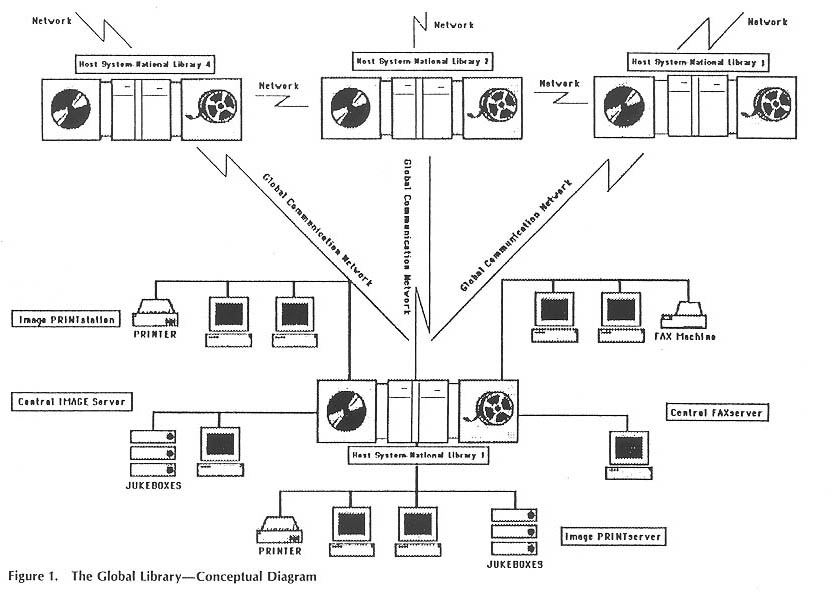
In early 1993, I presented the network connections of "The Global Library" in an over-simplified illustration as shown in Figure 1 (Chen, 1993). Take the national libraries as examples, global communications make it possible to connect toge-ther these libraries from different part of the world. They will become regional "knowledge centers" which can access information from the entire global "net-work of networks." High-density optical storage in jukeboxes makes a vast increase in global collection size possible. With the availability of a high-speed and broad-band global communications network, cutting-edge technologies such as multimedia and digital imaging, can be linked, so that texts, images, digital videos and voices can be transmitted from one part of the world to the other.
At the same time, however, nationalism becomes a stronger theme: building national collections, serving as an information source for national government, collecting national history, culture etc. The use of multimedia and Knowledge Navigator enable the delivery of these information as well as information of other countries to citizens' homes, schools, and offices. In this kind of environment, the knowledge world is going from a paper culture to an electronic one, and libraries will be deeply affected. In other words, printed information sources, such as books, journals, and archival materials, will not be enough. Digital information sources become essential.
HOW TO WORK TOWARD THIS GLOBAL LIBRARY?
Currently more and more libraries are starting to create limitless digital book-shelves. For example, as reported in a Wall Street Journal article, some law libraries in the US are busy in tearing pages of their books and journals in the stacks and scan them. While it will be decades before libraries become totally electronic, some of these libraries are starting to create limitless digital book-shelves of information sources and thus making good progress toward electronic digital libraries [Bulkeley, 1993]. For example, "the Columbia University Law Library in New York is creating 'Project Janus,' a 'virtual library' that can find and display on one computer screen the full text of any document among millions stored digitally as optic images. The project is the first library application of
digital full-text search and retrieval stored images" (American Library Associa-tion, 1994).
Once the information sources are available in digital form, they can be acces-sed, distributed, and transmitted easily in almost "no" time with "no" cost to the end-users over the global information network, such as Internet. Users around the world can also ftp (using the standardized file transfer protocol over Internet) to any specific electronic archive to obtain needed information and download it. With this kind of convenience, we are witnessing the fast proliferation of electronic journals and publications over the Internet network (Chen, 1994).
In a bigger national scale, for example, the National Agricultural Library in the US just proclaimed its commitment to "Electronic Library." It has announ-ced that on January 1, 1995, electronic information becomes the preferred medium for library materials in an all-out push to make NAL's services and its collection available in various electronic format worldwide. NAL is making this commitment because of its belief that "the current paper-based information delivery system is inadequate to keep pace with the needs of the modern agricul-turist." The NAL Statement of Commitment contained in the Phase 1 Final Report of the Electronic Information Initiative stated " Increasingly, information is produced in digitized form, and with recent telecommunications innovations and the Internet, the resources available to the computer literate researcher are expanding exponentially... [Consequently] NAL is taking the initiative in a systematic program of managing data in electronic form and establishing strate-gies for collecting, storing, and distributing U.S. agricultural information in electronic form" (NAL..., 1994) For more detailed information on this develop-ment, the readers are referred to this NAL report (US National Agricultural Library, November 1993). This reported can also be obtained electronically by ftp to the NAL.
With a major national library, such as the NAL, starts to take lead in going "digital" in this big way, for sure there will be more and much more to follow.
There has not been sufficient discussion on the possibilities of including high-resolution digital images and videos in real library applications, but this is also forthcoming in a matter of time. While there are more technological hurdles to overcome in dealing with digital image and video information for global sharing and transmission, they are not impossible. In fact, high-tech industry players are investing heavily in these developments, and positive technological results can be obtained in a matter of months.
BARRIERS TO THE GLOBAL LIBRARY
As expected, there are many barriers to implementing The Global Library. In 1987, when discussing the barriers to international information exchange at the first Pacific Conference on New Information Technology organized by me in Bangkok, Roland Brown, then President of OCLC, stated that despite the numerous obvious benefits, there are also substantial barriers to international library networking and resource sharing and to user access to international bibliographic and other information resources [Brown, 1987]. These include:
• Lack of interest on the part of information professionals to exchange infor-mation -- a lack of vision,
• Lack of common standards for both manual and machine-readable catalog-ing, interchange codes, protocols, character sets, etc...
• Distance and the availability and cost of telecommunications;
• Lack of foreign exchange to purchase equipment, SW and data acquired from outside the country,
• Language,
• Difference library customs,
• Difficulty in finding supportive local environment.
• Data compression, storage
• Servers
• The Conduit
• The set-top box
• The user interface
• Ordering and billing systems
INFORMATION SUPREHIGHWAY: THE GOOD,
THE BAD, AND THE UNAVOIDABLE
The great potentials of the information superhighway for fast global communica-tions and information sharing need not be further elaborated. All of us are either current or potential users of Internet, thus are well familiar with the "GOODs" of the information superhighway. Yet, nothing is "perfect." As we are in the midst of the evolving digital process, witnessing the planning, the construction, and the eventual offering of this superhighway, we, as library and information profes-sionals, have to be increasingly and seriously concerned on the potential use of this highway of all highways of digital information. Let me elaborate on some of the potential "BADs" of this development:
• "Content"-related problems will related to many difficult areas, such as:
- How to differentiate the valuable information from the "junk"? Is there an easy way to filter information -- to find the nugget from tons of mud and sands? What are the criteria used?
- Is "information-on-demand" a bad idea? Our answer is likely "no" or "not always." Then, how can information generated from libraries and information centers become the "information-on-demand" type, or, at least, how to compete with the real money-making "information-on-demand"?
- Will information superhighway eventually become "entertainment" super-highway," as raised earlier? How can the serious "educational" informa-tion compete with the popular "video games"?
Aside from the conduit, the current moneymaking "contents" have been mostly "game" and "entertainment" oriented, with computer video game com-panies such as Nintendo and Sega joining force with Hollywood motion picture makers, such as Paramount, etc... The current "players" are eager to exploit this information superhighway, and advises offered are plentiful in all high-tech weekly journals, such as Guy Kawasaki's column, etc... (Kawasaki, 1994). He said, "AT LAST, I'VE FOUND SOME-thing good about the information super-highway (aside from providing computer columnists with topics to write about): it's a wonderful opportunity for Macintosh multimedia mavens to make money off Hollywood. Hollywood's got content, but they need you to make it a digital realty..." Thus, the UNAVOIDABLES for the information superhighway are the fast production and the massive delivery of more and more multimedia informa-tion-on-demand, which include more and more high-tech driven computer games, videos, Hollywood type of entertainment contents, and commercial infor-mation. As the industry reports a minimum of $1-$2 million dollars investment for a single video game title, and millions and billions of huge sum investment to push for the production of entertainment and on-demand products for the information superhighway, library and information professionals do have every reason to be seriously concerned of the incredible lack of funding support for the deve-lopment of more serious "educational" applications. In fact, we should worry not only for the potential gloomy future of the libraries as equal players on this information superhighway which will be jammed with market-driven contents, but also for the entire nation where education has been at risk for sometime!
CONCLUSION
Despite of the potential difficulties, barriers, and challenges mentioned above, one thing is sure: that the technologies and the infrastructure are in place now for us to experiment an universal library. For the first time ever, lack of proper technology is no longer an obstacle. But, technology is not the end in itself rather the means to an end. We should not suffer from the loss of direction caused by preoccupation with technology.
Thus, at these crossroads, in addition to speculating on the libraries in the next millennium, what we must do is to make sure we can develop in this seemingly exciting networked environment, a vision for our library's future, and define its role in facing a new frontier. It is important for us to visualize that not only all types of libraries in our country would be connected to the super-network, but also globally all libraries would be part of the network as well. Furthermore, through the global information superhighway, digital information resources of all subjects, types, and formats would be available and accessible to anyone on the earth who wants it. We have a long way to see these "dreams" come true, but we must have these "dreams"!
Caught in the middle of the digital information revolution, between traditional academic conservatism and tantalizing possibilities of the hightech world, the right vision will chart the right course of our library and information developments, and ensure us that we will fit into this period of unprecedented, con-tinuous change and adjustment, and not be lost in the shuffling of this new digital visual information age, and be totally swept by the tidal wave of the "Entertain-Info" powerhouses.
Our challenges are indeed great! We have too much to lose by failing to accept and to act on these challenges!
REFERENCE
American Library Association. (1994, June). Fact Sheet on Libraries Online.. p. 4.
Bulkeley, William M. (1993, February 8). "Information age: Libraries shift from books to computers," The Wall Street Journal, p. B1.
Cauley, Leslie. (1994, May 18). "Interactive trials are trials indeed - Tough to start and tough to judge," The Wall Street Journal, pp. B1, B3.
Chen, Ching-chih. (1994, June). "What Bonus Information You Can Get from Internet?
Current Awareness and Free Electronic Publications/Services," Microcomputers for Information Management, 11 (2), 125-131.
Chen, Ching-chih. (1990, December). "The challenge to library and information professionals in the visual information age," Microcomputers for Information Management, 7 (4), 255-272.
Chen, Ching-chih. (1986, December). "Libraries in the information age: Where are the microcomputer and laser optical disc technologies taking us?" Microcomputers for Information Management, 3 (4), 253-266.
Jiegler, Barry. (1994, May 18). "Building the highway: New Obstacles, new solutions," The Wall Street Journal, p. B1.
Kawasaki, Guy. (1994, September). "Doing Hollywood: Finally, a reason to get on the information superhighway," MacWorld, p. 286.
Keller, John J. (1994, May 18). "They'll spend lots but lots less than they say," The Wall Street Journal, p. B1, B5.
Mello, John P., Jr. and Wayner, Peter. (1993, February). "Wireless mobile com-munications," Byte, p. 147.
"Multimedia and The First Emperor of China: Moving toward a digital know-ledge base." (1994, April). Multimedia Today, 2 (2), 68-71.
"NAL commits to 'Electronic Library' goal." (1994, January-March). Agricul-tural Libraries Information Notes (US National Agricultural Library), 20 (1-3): 1.
Olson, Robert L. (1988). "The Future of the Public Library," in The Future of the Public Library: Conference Proceedings. Dublin, OH: OCLC.
U.S. National Agricultural Library. (1993, November). The Electronic Informa-tion Initiative: Phase 1 Final Report. A Key Success Factor in the NAL Stra-tegic Plan. Submitted by Carol Ditzler, Caroline Early and Claudia Weston. Beltsville, MD: National Agricultural Library. 136 p.
Ziegler, Bart. (1994, May 18). "Building the highway:
New obstacles, new solutions," The Wall Street Journal, pp. B1,
B3.