PANEL ON EDUCATION/TRAINING RELATED TO NIT AND GII
Chaired by:
Ching-chih Chen
Professor & Associate Dean
Graduate School of Library and Information Science
Simmons College, Boston, MA 02115, USA
cchen@vmsvax.simmons.edu
INTRODUCTION
This Panel is on Education/Training related to NIT and GII. Education and training to me are always the most baseline necessity to enable us to get somewhere. We have all the information resources available, but if we don't know how to use them, those resources will not be able to have any effect on us. With all the networks available and all the technologies, if we don't have trained human resources, their efforts will be in vain as well. For these reasons, we are delighted that in our group we have a number of educators. So, I have pulled this session on education and training together, and have asked Bob Hayes to give a position paper. At the NIT '93 in Puerto Rico, he also addressed this area, and we had very good results after his talk. In fact, we even had impromptu lunch meetings with all the educators from Latin America, who got together to discuss mutual problems and issues in this important area. Bob has already prepared a rather extensive position paper, and, at this session, he will highlight some of the key points in that paper.
I don't know how to introduce Bob Hayes. Bob is sort of like the father of automation. All of us, particularly this group, know of his most distinguished career and accomplishments, so I shall take his advice and not go into any details, because that will take a long time. However, as I already mentioned yesterday at the beginning of the conference, he has been most instrumental in the success of this series of NIT conferences. His support has always been there. I can always count on Bob as both a supporter and critic. I'd like to thank Bob again for all his efforts. Bob, the podium is yours now.
8______________________
PANEL ON
EDUCATION/TRAINING RELATED TO NIT AND GII
AN EDUCATIONAL
COMPONENT FOR THE GLOBAL INFORMATION INFRASTRUCTURE*
Robert M. Hayes
Professor and Dean Emeritus
Graduate School of Library & Information Science
UCLA
Los Angeles, CA 90024
IFX1RMH@mvs.oac.ucla.edu
Introduction
This chapter is presented in a context that combines two initiatives. One is that by Professor Ching-chih Chen, who, starting in 1987, created the series of "New Information Technology" conferences, of which this is the seventh; their contri-bution to the advancement of knowledge throughout the world has been specta-cular. The second is that by the President and Vice President in setting objectives to develop a Global Information Infrastructure (GII); the initiative for a national information superhighway provides a starting point for achieving that objective, an initiative that has galvanized the country as reflected in the explosion of journalistic commentary during the past year or so.
The purpose of this chapter is to identify the needs for education of librarians and information specialists as components of the GII and for faculty qualified to provide such education. In this chapter, the new information technologies include computers, telecommunications, and multimedia, working both indepen-dently and in interaction with each other and their users. The GII encompasses the means necessary to use those technologies in support of international pro-gress, including not only the structures necessary for the technologies themselves (i.e., for their continued development and production, for acquisition and instal-lation, for maintenance and logistical supply), but the persons who are necessary for the effective utilization of those capabilities. It is those persons who are the focus of this chapter.
The chapter consists of three major sections. The first section, Quantification of Information Development, establishes the major context, with a discus-sion and quantification of the status of individual countries as national "infor-mation societies," considering both information manpower and information technology. The objective of this section is to establish manpower needs, that will be met by educational programs for the GII and the role of new information technology in it, and the availability of a new information technology infrastruc-ture that is able to support the operation of such educational programs.
The basis for this section is a model presented at the Hong Kong NIT'92 for the "fine structure of national information economies," with some additions made to it in order to provide a more concrete means for estimation of the "level of information economy development." It provides a means to quantify the past and current situation in specific countries (with respect to information manpower and information technology) and to project the future situation in 5 to 10 years.
That model is applied to a number of specific countries in Latin America (Brazil, Chile, and Colombia), Asia (Indonesia, Malaysia, and Thailand), and Eastern Europe (Hungary, Poland, and the former Soviet Union). The purpose in doing so is to illustrate the kinds of manpower needs to be expected and the means by which such estimates can be made and used for manpower planning of this kind. For each, the status of information manpower and information techno-logy is estimated for the years 1980, 1990, and 2000.
Based on that, the section concludes with estimations of the flow of students required to achieve growths in manpower implied by those estimates (including attrition), which would lead directly to estimates for numbers of university facul-ty needed to handle that flow -- the primary concern of the chapter.
The second section, Requisite Instructional Programs, turns to necessary qualifications for such faculty as represented by both the curricular objectives, personal skills, and necessary technological support in institutional facilities of new information technologies and in national technological infrastructures.
Three specific curricular objectives are identified:
• Second is the integration of new information technologies into general curricula (e.g., in education, library and information science, management, etc.), with emphasis on their use for meeting societal objectives within the areas served by those curricula; of special importance is the identification of potentials for creating new products and services.
• Third is providing a more general overview of social and economic deve-lopments affected by the new information technologies. The discussion of the necessary technological support identifies hardware, software, content, and telecommunications capabilities required to meet objectives.
The section proposes that an international institute for new information technology education be established with the identified objective of serving as a focal point for development of the faculty within each country, for the sharing of educational experience and curricular development, and for managing the process of developing faculty skills. Alternative means for operating such an institute are reviewed and briefly assessed, including doing so at a specific institution, as part of an international organization, or as an independent structure, that is not part of any specific existing organization or country, but instead operates as a "movable feast" (much as already so successfully represented by the series of NIT Con-ferences). The section concludes with an estimate of financial and management requirements for such an institute.
LEVELS OF NATIONAL INFORMATION DEVELOPMENT
A paper entitled, "A simplified model for the fine Structure of National Infor-mation Economies," was presented at the NIT '92 Conference in Hong Kong, November 30 -- December 2, 1992 (Hayes, 1992). It summarized the large-scale structure of information economies based on Marc Porat's (1977) landmark study, The Information Economy: Definition and Measurement, in which he re-placed the traditional three sectors of the national economy -- Agriculture, Indus-try, and Services -- with four sectors, adding an information sector to them. The information sector he further subdivided into two components -- primary and secondary information sectors -- the former included all persons working in organizations whose primary product or service was essentially information-oriented and the latter included those working in all other organizations but whose activities were also essentially information-oriented. The Porat study showed that over 50% of the U.S. workforce today is engaged in information-related activities, almost equally divided between the two parts.
Within each subsector, information products and services can be roughly, but usefully, classified into five components, with obvious parallels across the sub-sectors as illustrated in Figure 1. The parallels across the subsectors highlight the fact that management has the choice between committing resources to them inhouse or contracting for them from the primary information sector. For valid management reasons, there does appear to be a steady trend toward outsourcing to the primary information sector, especially in areas such as software development and training.
The model presented at NIT'92 was intended to provide a descriptive basis for assessing a more finely grained structure. It is based on just a few parameters with values currently used to represent each as listed in Figure 2.
For two categories -- management and levels of information use -- the para-meter is the relevant proportion of total employment in an industry. The value for "management" is taken uniformly, over all categories of organization, at 10%. The values for "levels of use" (information and noninformation) are derived from the input/output accounts for the United States and reflect the relative levels for purchase of products and services by different categories of organization.
The values for the ratio "In-house/Out-source" are taken at 3 to 1 for all func-tions except those specific to each type of industry. This reflects data on that ratio for different specific functions. However, for information industries, there
*The boundary between the two sectors is uncertain
and changes over time.
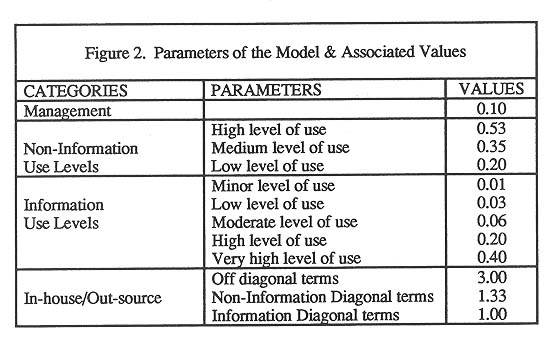
is evidence of a strong "diagonal dominance," with transaction industries pur-chasing heavily from transaction industries, information hardware purchasing heavily from hardware, and distribution purchasing heavily from distribution. For those diagonal elements, therefore, the ratio is taken at 1 to 1. For noninfor-mation industries, there is a similar diagonal dominance, taken at 1.33 to 1.
National Policy Planning
To this point, the model has been described as a representation of the informa-tion economy of the United States. If that were the end of it, there would be at most descriptive value. The intent in developing the model is to provide a basis for assessment of other contexts, especially those in countries in transition through the stages from subsistence agriculture to industry into the information age. To that end, one more parameter is needed -- one that represents the stage or level in which development is exhibited by the extent to which various kinds of information resource are used within the economy. That parameter (shown by "X") enters into the model as a multiplier on the percentage values shown earlier, as shown in the matrix of Figure 3.
The value for X in the prior presentation was based on a subjective assess-ment of the level of information infrastructure development. For the purposes ofthis chapter, however, a computation is used for determining that value, as follows. Let:
A = percentage of workforce engaged in agriculture
I= percentage of workforce engaged in manufacturing and other industry
S = percentage of workforce providing services in commerce
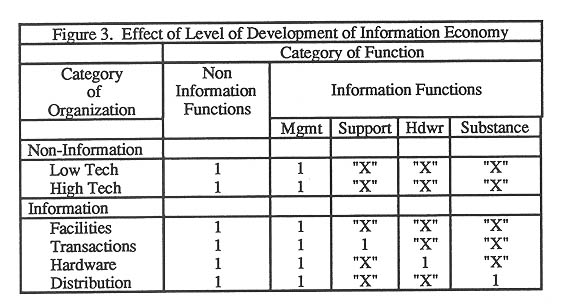
From these, calculate:
P = percentage of workforce engaged in subsistence agriculture = A*A/(A+M)
Then, X = 2*(E/50)*(S - 0.20*(A - P + I + S)).
The rationale underlying this calculation is as follows: The portion of the employed population engaged in information work includes those in the primary and secondary information sectors (taken as equal; hence, the factor 2). Those in the primary information sector are primarily in services, but that includes many noninformation activities; overall, though, the noninformation activities appear to be relatively constant at about 20% of the nonpeasant population, so those are subtracted from S. The factor (E/50) is used to deal with substantial underre-porting of employment, especially of the peasant population.
Librarians as Components of the Information Economy
Libraries are an identified part of the information economy. But clearly, when we talk of 50% of the nation's workforce, we are dealing with a large-scale phe-nomenon, based on a broad definition of information work, within which libraries and librarians are almost invisible. General studies of manpower distributions have, as a result, not given a clear picture of more specific elements at a level that would permit meaningful examination of libraries as a component of large-scale information economies. It is largely for this reason that the model being present-ed here was created.
In the United States in 1989, according to Bureau of Labor Statistics data, there were about 212,000 librarians, including both professional and nonprofes-sional staff of libraries and library-like agencies. They were therefore about 1.3% of the workforce for substantive information staffing. The librarians are heavily concentrated within distribution industries, especially in educational institutions. For example, the major university libraries (those that are members of the Association of Research Libraries) in 1989 employed about 35,000 persons (25% being professionals); higher education as a whole employed about 90,000. Public libraries employed another 90,000. That leaves about 32,000 for the rest of industry, with about half being professionals.
Illustrative Application of the Model
To illustrate the model and, as a result, to provide data on which to assess the magnitude of needs for librarians and information specialists, it has been applied to nine countries, three from each of three regions of the world:
1) Brazil 1) Russia 1) Indonesia
2) Chile 2) Poland 2) Malaysia
3) Columbia 3) Hungary 3) Thailand
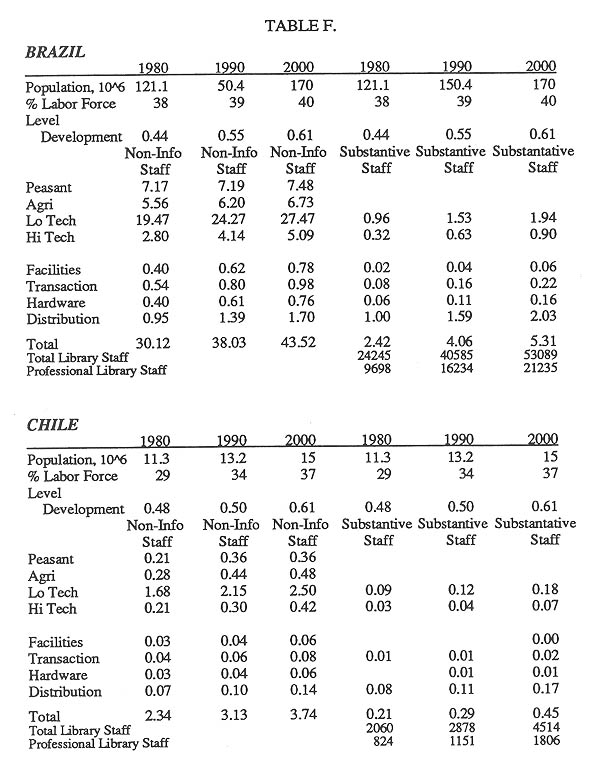
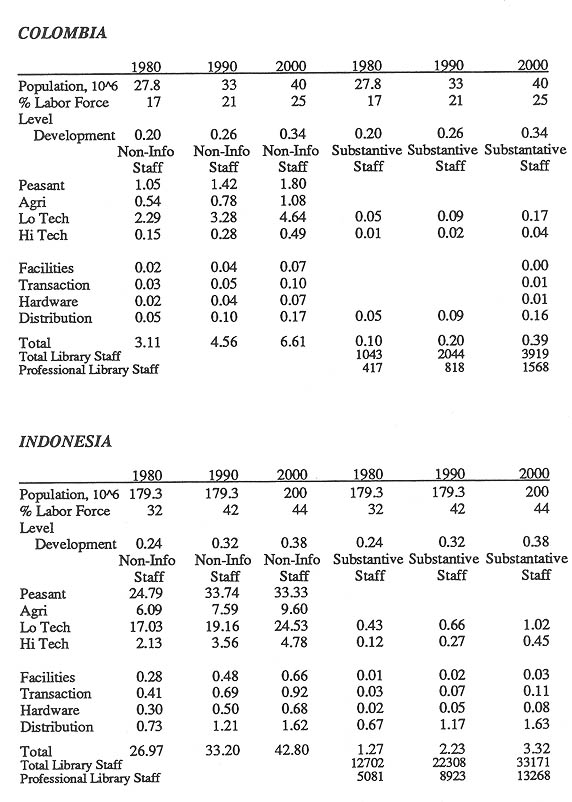
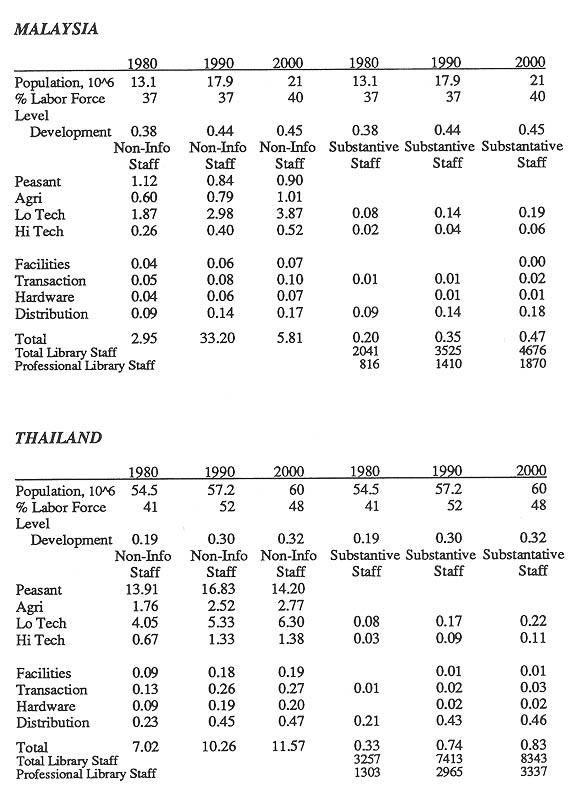
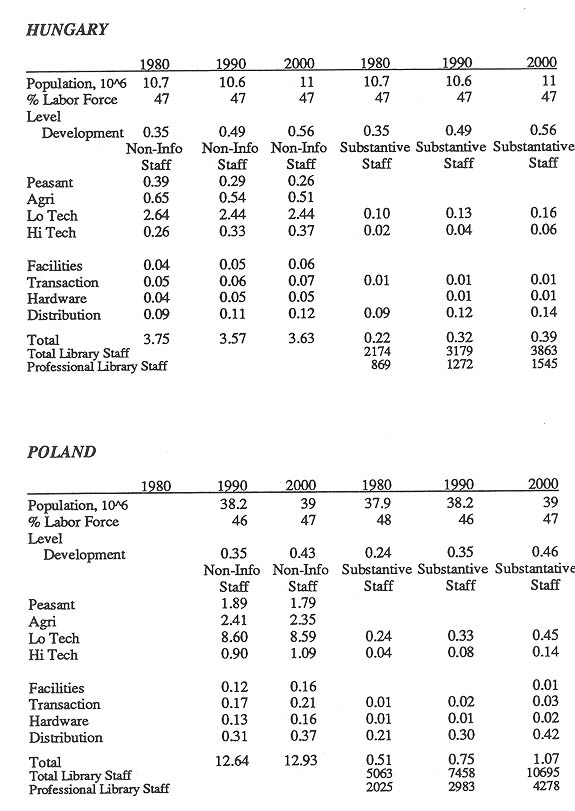
The results of the application of the model to the three time periods are pre-sented in Appendix C. Among the estimates are those reflecting the capabilities for supporting a technological information infrastructure, represented by employ-ment in the Transaction, Hardware, and Distribution industries. These results from the model can be compared to the UN data for numbers of telephones, tele-visions and radios, and newsprint, respectively. The following are the regres-sions for those three comparisons:
(Transaction Employment) = 4,430 + 2.19* (Telephones), R-square=.17
(Hardware Employment) = 189,000 + 308* (TV), R-square= .54
(Distribution Employment) = 697,000 + 139* (Newsprint), R-square= .25
Although the correlations are relatively small, they clearly show a positive relation between the respective variables.
Of the measures of information infrastructure, the number of television and radio sets is the one that appears best to reflect information readiness. In fact, the regression of the model's measure of level of development on the number of TV and radio sets (per thousand) is as follows:
Level of Development (X) = 0.21 + 0.00335* (TV)/1000, R-square = .50
That suggests a conjecture that a minimum level of development, below which the infrastructure cannot reasonably support an information economy, could be 0.21.
Finally, and of most importance, the model provides estimates of the numbers for library staff, both total and professional. To test the extent to which they are realistic, the following compares the estimates from 1980 from the model with published data (Fang & Songe, 1980), included in Appendix B, for the number of members of societies of librarians in each country, as shown in Table 1.
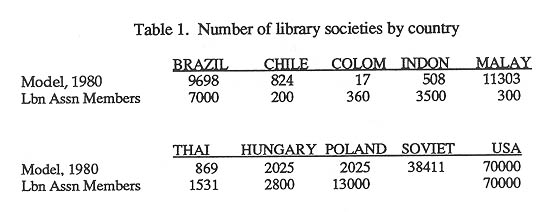
NEEDS FOR STAFF DEVELOPMENT
General Economic Objectives
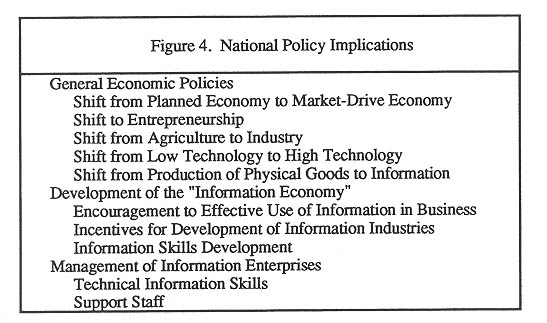
I want to place the needs for staff development in the context of national policies, because in large part they relate to the needs for business planning in an informa-tion-based, market-oriented economy. Underlying them is the nature of general economic objectives as shown in Figure 4. They are all essential if an informa-tion-based, market-oriented economy is to be achieved.
Assuming that the basic, general economic policy decisions have been made, there are less overreaching but still crucial elements of national policy. The first is to provide encouragement and incentives for the development of an informa-tion economy. A most crucial problem with information is the fact that there is differential use. Those who know the value of information, and those who know how to use it are the ones who do so. But all statistics show that there are 10.0% to 20.0% of those who should be using information. Therefore, national informa-tion policy should be concerned with how to encourage managers and staff at all levels to use the information they need for maximally effective operations.
Information Skills Development
To serve such national objectives requires trained information professionals -- librarians, information scientists, and information managers -- to effect the
changes, to implement and operate the systems, and to increase the awareness of information and its value. Support to this kind of educational investment clearly
should be a priority national and international commitment if the GII is to be developed.
If information resources are to be used effectively,
there is need for mana-gerial, technical, and professional skills in the
use of them (see Figure 5).
|
|
| Management skills
Technical knowledge of Information Processes Knowledge of the range of Information Resources Operational experience with Information Technology Technical skills in Systems Analysis & Design Practical awareness of Information Applications |
Perhaps the most important are skills in management of information activities. Beyond the usual needs in management of people, resources, and money, this requires special awareness of technical specifics of information activities.
• Second, there is the need for solid knowledge of the full range of informa-tion resources that are important to corporate operations, decisions, and production. Some of these are internal information, generated by corporate data processing systems, based on data about corporate operations; these are the primary substance of management information systems. Beyond them are the great variety of external information sources -- the publications, databases, governmental statistics, and scientific and technical information sources. The information resource manager needs to know what kinds of information are available, but even more important how to identify and acquire those that are needed for specific requirements, as they arise.
• Third, there is the need for operating experience with the information pro-cessing technologies. These are the means by which information processes are carried out, and the information resource manager needs to have a solid understanding of them. Central among them are the technical tools of database management -- indexing structures and vocabularies, file struc-tures, software for search and retrieval of data from files, tools for data analysis and presentation.
• Fourth, there is the need for technical knowledge of "systems analysis"--the means by which technical decisions can be made about the choices among alternatives that will meet the objectives of the corporation. I must empha-size that this is far more than the traditional "systems and procedures" that have become such standard parts of corporate data-processing operations. Although the issues of concern in systems and procedures are clearly important and indeed are included in the work of systems analysis, there are much larger problems and more sophisticated methods involved in "infor-mation systems analysis and design" than simply systems and procedures in the traditional sense.
• Finally, there is the need for practical awareness
of the applications in which information is needed -- in corporate management,
finance, market-ing, product development, manufacture, and distribution.
The information manager must be able to assist the corporate manager in
implementing these applications to assure maximum benefit and cost-effective
operation.
Clearly, these kinds of skills can be obtained in a variety of ways, from a variety of sources, and in a variety of institutional contexts. For example, industrial and commercial private sector training programs have been a growth industry in the United States, and many of them concentrate on training in these kinds of skills. For the purposes of this chapter, though, the traditional academic program, using formal courses in a university setting, will be used as the model.
Although in principle such academic programs can be provided by schools of management or computer science, the knowledge of information processes, information resources, and the means for serving users in application of them are almost the exclusive domain of the schools of library and information science. Those are the schools that prepare persons for work as information professionals, with both the technical skills and the service commitments that characterize the field. The traditional curricula in those schools emphasize the information pro-cesses, resources, and services to users. To those must be added coursework on the new information technologies, systems design and analysis, and the applica-tions of them.
Three levels of coursework should be considered:
• As specialized courses providing extensive experience and skills in the new information technologies, at technical and operational levels
• As advanced, expert courses providing high levels
of skills for professional qualification and practice as a specialist in
new information technologies
I will not try to lay out the syllabi for these three levels of coursework, but there already is a solid base of experience in degree programs throughout the world for doing so.
Kinds of Requirements to Meet Instructional Needs
Whatever the specific curricula and syllabi may be, there are two essential sets of requirements for successful degree programs: First, an adequate number of qualified faculty, and, second, an adequate technological infrastructure. It is to those that I now turn.
Faculty qualifications must be present in the general faculty -- those who are concerned with the generic information processes, resources, and services and will assure that the first level of coursework provides the necessary knowledge of the use of the new information technologies in practice. They must also be pre-sent in the specialized, expert faculty -- those who provide the second and third level of coursework.
Technological support to instruction requires a national infrastructure in tele-communications, in the availability of the computer technologies, in access to the multimedia information resources, and in the necessities for supplies, maintenan-ce, and general logistical support. In principle, this need is likely to be the signi-ficant barrier, because meeting it requires national investment and depends on the level in development of the local information industries as has been previously discussed.
It also requires a local, institutional infrastructure -- availability of an adequa-te number of multimedia personal computers with sufficient capability and a local area network (LAN) with national and international interconnections. Of course, such a local infrastructure does require investments in purchase of hard-ware and software, in installation and maintenance, and in staffing, but there are no problems in principle in making those investments, provided the national infrastructure is there.
Magnitudes of Needs
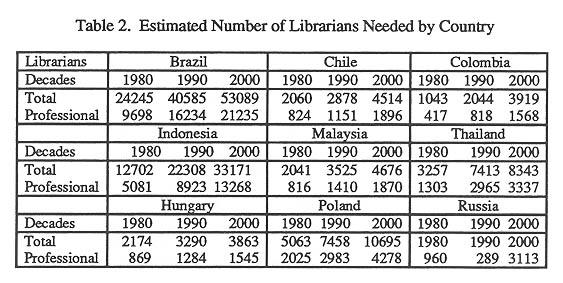
I turn now to the crucial issue: What is the magnitude of these needs? It is obviously a function of the numbers of students to be educated. In Appendix C, through application of the model presented earlier, estimates are made of the number of professional librarians in each of the countries examined. Table 2 summarizes those data.
Using Colombia as an example, the following are the implications of these results: First, between 1990 and 2000, the growth of Colombia's population and of its information economy will require 750 more professionally educated libra-rians or 75 per annum. In addition, there will be attrition of the existing staff of 818; at 7% per annum, that would add another 55, for a total of 130 per annum. In Appendix B, the number of potential library school students in 1990 is estimated at 205, so the needs are commensurate with the available pool.
Table 3 summarizes that kind of analysis for each country, together with data from Appendix B estimating the pool of available students.
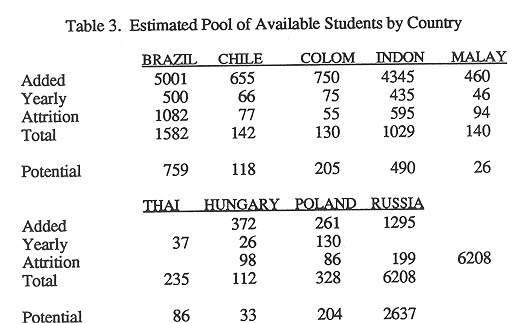
The picture is one of varying ability to meet the needs for the requisite num-bers of librarians and information specialists from the potential pools of students. For most of the countries the shortfall is large enough that filling it may require developing incentives to attract students.
Turning to the more critical issue of requisite numbers of faculty, a ratio for student/faculty is taken at 20 to 1; the number of faculty with specialties in the new information technologies is taken at one third of the total. The results are compared with the estimated potential shown in Appendix B in Table 4.
Again, the picture is one of varying ability to meet the needs for the requisite numbers of faculty, especially those with specialties in the new information technologies from the potential pools of faculty. For most of the countries, though, the shortfall is such that it probably can be filled without difficulty. An evident problem, though, is the lack of "critical mass" for the majority of these countries. Faculties of less than 10 persons are marginal in so many respects that this is a matter of concern.Table 4. Potential Requisite Number of FacultyBRAZIL CHILE COLOM INDON MALAYFaculty 79 7 7 51 7
New Info 26 2 2 17 2
Potential 64 6 22 38 2
THAI HUNGARY POLAND RUSSIA
Faculty 12 6 16 310
New Info 4 2 5 103
Potential 9 6 33 202
The issue at hand is how to provide these faculties with the requisite skills for education of students in the new information technologies. Both the general faculty and the specialists need to develop their own knowledge on which to base their curricula, syllabi, and instruction.
THE MEANS
Two contexts for providing such faculty qualifications can be considered: locally based programs, on the one had, and regional and international programs on the other. The problem with the first context, for several of the countries, is the small size and limited resources. Progress by "pulling oneself up by the boot-straps" is not very likely. I therefore focus my attention on the latter context and do so by presenting a prospectus for a proposal of what I call an International Graduate Institute for New Information Technology Education (IGINITE), with the mission of coordinating such regional and international efforts for developing skills of both generic and specialist faculties in schools of library and information science with respect to the new information technologies.
IGINITE will serve as a supplement to locally based programs and will work through regional groups of countries. It will be concerned with the development of curricula and syllabi, as well as the production of texts and instructional materials. It will establish a pool of master teachers, both internationally and within each region, in the necessary curricular components. It will schedule and conduct regional workshops, training sessions, and conferences at which master teachers will work with faculty of schools of library and information science within the region in exploring methods of teaching about the new information technologies.
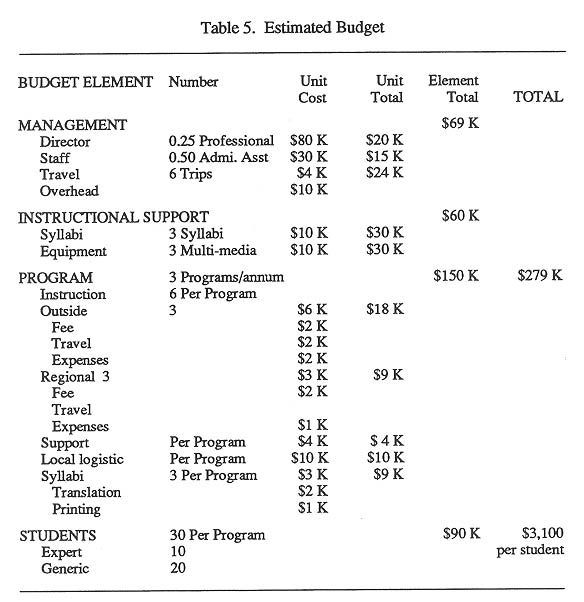
To carry out such a program will require a small central management staff working from an appropriate institutional base -- a university or professional society. The following (Table 5) is a tentative budget, presented as a starting point for discussion. It assumes that 2-week workshops will be scheduled in a year in each of three regions; each workshop will cover three major curricular topics -- management, technology, and application. Each topic will be covered by two master teachers, one from the region and one from an international pool.
Assuming that each workshop involved 30 participants, of them 10 specialists in the new information technologies, the budget presented in Table 5 would average about $3,000 per participant -- a bargain by any measure.
REFERENCES
Porat, M. U. (1977, May). The information economy: Definition and measure-ment. Washington, DC: U.S. Department of Commerce, Office of Telecom-munications.
Siegel, D. and Griliches, Z. (1991, April). Purchased services, outsourcing, computers, and productivity in manufacturing. Cambridge, MA: National Bureau of Economic Research.
United Nations Statistical Office. (1992). Statistical yearbook. Annuaire statis-tique. New York: United Nations.
In Tables A, B, and C, derived from data published
in the United Nation Year-book of Statistics (1992), there are additions
to be noted. First, the data reported in the UN Yearbook showed less than
11% of the employed workforce engaged in agriculture, but data from all
other sources showed it at 33%, so the UN repor-ted data for Colombia for
total employment and for employment in agriculture has been modified to
reflect 33% agricultural employment. Second, the UN data for total employment
does not quite equal the total of employment in the several sectors; the
difference is shown for each country in the row labeled "Error in Employ."
Third, calculations have been made of the percentages of employment in
each of the three sectors (agriculture, industry, and services).
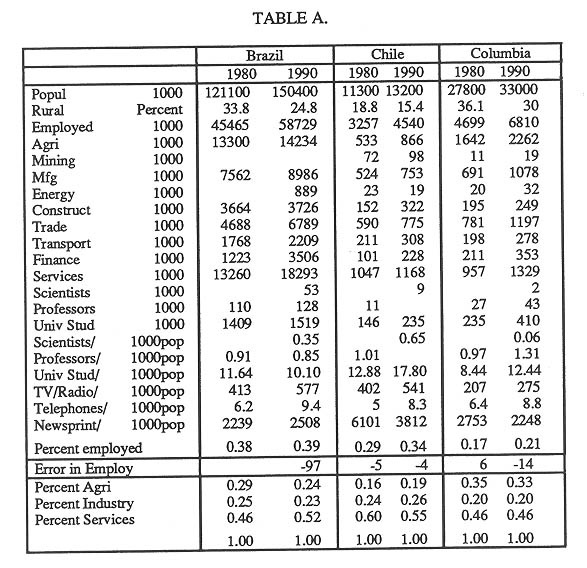
TABLE C.
|
|
|
|
|
|
| 1980 1990 | 1980 1990 | 1980 1990 | 1980 1990 | |
| Popul 1000
Rural Percent Employed 1000 Agri 1000 Mining 1000 Mfg 1000 Energy 1000 Construct 1000 Trade 1000 Transport 1000 Finance 1000 Services 1000 Scientists 1000 Professors 1000 Univ Stud 1000 /1000popScientists Professors /1000pop Univ Stud /1000pop TV/Radio /1000pop Telephones /1000pop Newsprint /1000pop Percent employed |
10700 10600
43 35.7 5044 4978 1113 907 1676 1496 398 336 488 578 404 427 966 1234 35 11 12 62 66 3.25 0.99 1.14 5.78 6.18 809 1001 11.8 17.8 5695 6348 0.47 0.47 |
37900 38200
41.9 38.2 18005 17552 5390 4597 539 608 5089 4336 154 149 1415 1321 1582 1653 1417 1127 372 338 2434 3084 33 57 66 454 408 0.85 1.51 1.73 11.97 10.68 544 720 9.5 13.7 3570 1022 0.48 0.46 |
266000 288600
37.5 33.9 125626 124971 25236 22761 36891 35400 1240 2550 9694 9800 11956 10225 649 720 28522 31425 1000 365 404 5235 5273 3.47 1.37 1.40 19.68 18.27 778 1008 8.9 10 4007 4338 0.47 0.43 |
248700 250000
26.3 24.8 99303 116877 3529 3391 979 733 21942 20434 1405 1584 6215 7087 20191 24055 5120 6620 8351 13172 31569 39802 949 306 505 7573 8000 3.80 1.23 2.02 30.45 32.00 2673 2936 40 50.9 46861 52026 0.40 0.47 |
| Error in Employ | 0 | 386 -339 | -11438 -12090 | -2 1 |
| Percent Agri
Percent Industry Percent Services |
0.22 0.18
0.41 0.37 0.37 0.45 1.00 1.00 |
0.30 0.26
0.40 0.37 0.32 0.35 1.02 0.98 |
0.20 0.18
0.30 0.30 0.40 0.42 0.91 0.90 |
0.04 0.03
0.31 0.26 0.66 0.72 1.00 1.00 |
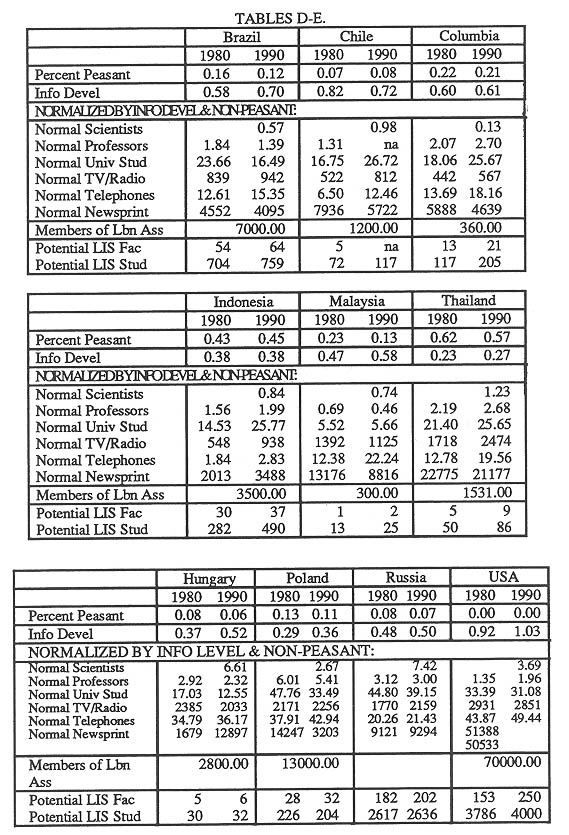
APPENDIX B: CALCULATIONS FOR THE MODEL
The following calculations are for data used in the analyses presented in this chapter. Let:
P = Percent Peasant A = Percent Agriculture
I = Percent Industry S = Percent Services
E = Percent of Population Employees X = Info Devel
P = A*A/(A + I)
X = 2*(E/50)*(S - 0.20*(A - P + I + S)
Normalizations are calculated to compensate for the effects of level of informa-tion development on the capability to provide specific kinds of information resources, including people with information-related qualifications. They are calculated as follows:
Normalized Scientists = (Scientists /1000pop)/(X*(E - P))
Normalized Professors = (Professors /1000pop)/(X*(E - P))
Normalized Univ Stud = (Univ Stud /1000pop)/(X*(E - P))
Normalized TV/Radio = (TV/Radio /1000pop)/(X*(E - P))
Normalized Telephones = (Telephones /1000pop)/(X*(E - P))
Normalized Newsprint = (Newsprint /1000pop)/(X*(E - P))
(i.e., each of the values per 1,000 population is divided by the product of Info Devel by percentage of employment that is nonpeasant).
The values for members of library associations are taken from Fang and Songe, (1980). The values for "Potential LIS Faculty" and potential "LIS Students" are calculated at 0.05% of the total number of Faculty and Students, respectively.
See Tables D-E.
APPENDIX C: RESULTS FROM APPLICATION OF THE MODEL
Table F shows the results from the application of the model to each country in turn.