PANEL ON GLOBAL LIBRARY, CULTURAL AND HERITAGE INFORMATION NETWORK, AND ELECTRONIC INFORMATION SHARING
DIGITAL GLOBAL CULTURAL AND HERITAGE INFOR-MATION NETWORK: PERSONAL VIEWPOINT
Ching-chih Chen
Professor & Associate Dean
Graduate School of Library and Information Science
Simmons College, Boston, MA 02115, USA
cchen@vmsvax.simmons.edu
Thank you very much, Bob. I have been admiring Bob's work for many years, and every single time I receive kind words like these from Bob Hayes, aside from being appreciative of these compliments, I am also very worried. I wonder how I can possibly live up to even just about one tenth of the things that he said about me.
But, anyway, in terms of the digital applications of information, and the con-ceptual framework thinking of the digital libraries in the future, this is certainly one area which I have been involved in for quite sometime -- not just this year, or last year when these were "in" words and hot topics for this information super-highway era, but over a decade ago. Prior to the digital multimedia applications, it was interactive videodiscs, in which I started my work over 10 years ago. In fact, we celebrated the 10th anniversary for PROJECT EMPEROR-I this past October. Ten years ago, when few knew what was going on, I proposed to do what was later to be called "interactive multimedia" work. Many thought that I must be crazy to propose something like interactive videodisc applications. It was very difficult to push for something which was new, difficult, and also ''cold" at that time, because so few were doing them, and it was very lonely with very few to talk to. Fortunately, it is great in a way to work in a high-tech area, because everything is so dynamic and has such a short time span. In a relatively short 10 years, what was cold becomes hot, and what was out becomes main-stream. But we have to pause and ask why we are doing these things. Is it because this type of application is going to be popular? Is it because this type of application is considered to be the "in" thing? Or, is it because this is the better way to deliver effective information services? If so, then, what happens when it is "out"? How I look at technology is strictly as a tool; there is no sentimental attachment to it. Therefore, as we are discussing GII, and specifically this morning the global cultural and heritage information network, I wish to share with you a number of thoughts on these.
My strong viewpoint on digital global library and information superhighway is already stated clearly in my paper, and therefore, in the interest of time, I shall not repeat them except referring you to it.
This paper, first of all, shows you that a "global library" has been in my mind for a long time. Also, the main points concluded here are worthy of our atten-tion. Interestingly, many of them have already been brought out during previous discussions -- barriers, the good, the bad, the future directions, and implications for the information superhighway.
In addition, yesterday, when Don Riggs talked about strategic planning, today we are sitting here for these intensive roundtable discussions, talking about the problems and issues, searching for future directions, and so forth. This is the beginning of the planning process among us for GII. Unfortunately, we don't see this type of thing happen too often in societies, in different programs, because it is not easy to have this type of activity. But, this is very important!
From one of the recent issues of Wired magazine, some of the statistics are very enlightening:
• The traffic of NSF backbone traffic in one month
(March 1994) . . . . . . . . . . . . . . . . . . . . . . . . . . . . . . . . . . . . 20.7%
• The growth of World Wide Web for multimedia information
delivery over the network via Mosaic, etc. in one month . . 32.9%
Talking about money, it is estimated that by the
year 2000, telecommunica-tions is going to be a 1.3 trillion dollar business,
compared to the size of the U.S. defense budget at 270 billion dollars
now. This is mind boggling! Considering what Woody said yesterday, these
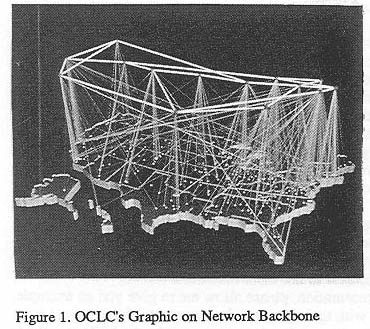
figures suggest incredible potentials for us. Figure 1, OCLC on
network routing in 1992, already showed us the crazy and complicated picture;
we can well imagine how bad it is now. Then, in the multi-media technology
area, billions of dollars are being invested by high-tech and communications
companies. Steve already mentioned the present capabilities of transmitting
multimedia information over the Internet. Although it is still rather rigid
for high-resolution graphics and digital videos, I can assure you that
the technological problems will be overcome in the very near future. The
conduit and technologies are all here.
Yet, most people are talking only about the technologies
and are excited with them. We must remember that the main thing and the
most important thing is content. Where is the content? With all
the capabilities focusing on the building of the in-formation superhighway,
what is going to be on it? From a GII point of view, take national libraries,
na-tional archives, and nation-al museums for examples. They are all major
nodes of
Figure 1. OCLC's Graphic on Network Backbone nodes
of the global infor- mation infrastructure. It is not a problem to connect
them globally from a technological point of view. The connecting lines
can be built much more easily than the other factors involved -- politically
and conceptually -- in global information resource sharing.
Environmentally, we also need to realize that there are numerous ways of interpreting the definition of content. In the last five years, I have been privi-leged to participate at the highest level roundtable discussion meetings on the topic of multimedia, organized by Prof. Martin Greenberg of UCLA, in the Los Angeles area. These roundtables were attended by the CEOs, presidents, and directors of multimedia development of almost every major high-tech company devoted to multimedia in and out of this country. Yet, so very few educators were present, not mentioning those with a library interest (in some years I was the only one). In the 1994 meeting, I heard that millions and billions of dollars have been invested in the creation of digital multimedia titles with a minimum of at least over 1 million dollars per title. Yet, by and large, the great majority of the production has been in the entertainment area dealing with titles similar to video games -- with the Nintendo and Sega mentality. Only a very small percen-tage are dealing with reference and more serious subject matters. While not disputing the value of video games, one can't help wondering whether the infor-mation superhighway is going to be more like "entertainment superhighway" or, at best, "edutainment superhighway." If so, what are the implications for society at large and the future of libraries in particular.
On the other hand, we know very well that the great libraries, archives, and museums in each country around the world are holding great treasures with price-less knowledge bases. Not only that, each country has its own most valuable information resources, regardless of whether they are in digital or nondigital forms.
Turning to the cultural and heritage area, for example, the national libraries, archives, and museums in each country are holding priceless cultural and heritage treasures of that respective country. A country can be extremely poor; yet these treasures are the only things that no one else in the world possesses, thus be-comes priceless. For poor countries, these are not in digital form, and ways have to be found to enhance global access to this nondigital information. Thus, think-ing in terms of the global information infrastructure, we need to find ways -- conceptually, politically, economically, and technologically -- to plan and develop cohesively a global infrastructure that connects these priceless treasures together. As Dave said yesterday, we need to at least find ways to develop pointers that point to these treasures, whether they are available digitally or not.
These treasures are the very content and knowledge base of which we are the keepers, organizers, collectors, and disseminators. Having planned and develop-ed such an infrastructure, we can then make the best use of technology to enable people around the world to be able to use these resources.
Now, at the end of my presentation, please allow me to give you an example. In the last five years, in line with technological development, I have moved from R&D work in interactive videodisc applications supported by the NEH into R&D work related to digital imaging and the creation of digital multimedia CD-ROMs. This resulted in the multimedia CD-ROM of The First Emperor of China avai-lable for both Mac and PC Windows™ platforms and published by The Voyager Company for worldwide distribution. This is the CD-ROM which Bob men-tioned earlier as an award-winning product and was named as one of the "50 Best CD-ROMs" in 1994 by MacUser.
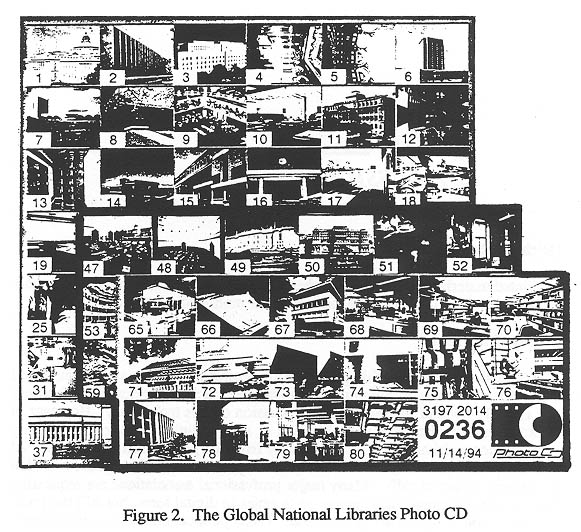
Riding on the knowledge and experience gained in this project, this year I have been working on a prototype digital project on the global national libraries. At this moment, over 30 national libraries around the world have participated, and a Photo CD has been produced with the digital images of these libraries stored on them. Descriptive information on these libraries are stored on micro-computers. The existing software can retrieve any of the image and associated text easily, and the image can also serve as a iconic pointer to the national library's collection. The retrieved image can also be processed and the desired portion transmitted via communications network to the requester in remote locations. Any part of the text information can also be searched and retrieved easily. Figure 2 shows the Photo CD images of the world's national libraries.
In addition, all the graphic and textual information
can be used to develop a World Wide Web application for easy retrieval
by those who have such type of global network connection. The pointer information
can further be connected to other national library information resources
available on the Internet. For exam-ple, if the OPAC information of the
library is available on the Internet, then connections to it can be made
very easily. The technology problems are very easy to solve, but others
such as those related to copyright, intellectual properties, security of
information, multinational cooperation, etc. are very complex and
cannot be generalized easily.
This is a simple demonstration that once information is on digital form, they can be shared easily, and via the available global information infrastructure, an information seeker will be able to access invaluable information on a given subject from far away countries from their own desktops.
So, in conclusion, if the ultimate high-speed information
superhighway is built, we need to know what information is going on it.
I am so delighted that some of you are able to attend this conference from
other far away countries. You are holding some of your most valued national
cultural and heritage infor-mation and knowledge base. Don't keep them
in the four walls of your library, your archive, and your museum. Let's
find a way to connect your rich resources to those of other countries,
so they can benefit users globally. Thank you.
Q & A_________________
DISCUSSIONS
[Richard Hsieh]
In printed material, university publishers are known to publish credible and scholarly works. Do you see such a movement for multimedia materials?
[Ching-chih Chen]
It is a good question. At this point, we are seeing some mismatch. Actually, I really don't want to get into multimedia here too much in our discussion because this is really not and should not be a discussion on this technology. However, it does not matter whether it is multimedia or simply digital (a lot of them in my view are not multimedia), it differs greatly from the print-based publication. At this time, most publishers are still very much print-based, although the situation is changing rather rapidly. Many major professional associations are requesting their authors to submit their papers on floppies in digital form, but still the types of publication outcome are print-based. These publications are not interactive, and not the kind of things which enables the readers to be able to retrieve infor-mation quickly and electronically. It is a step ahead though, but a slow process. As to the multimedia product, the definition of trash is very subjective. Regard-less of what type, the process of producing a multimedia title is extremely labor intensive. It needs people with tremendous devotion and vision; there is a serious lack of such types of people. Furthermore, because multimedia projects are very labor intensive, we see many projects, including those initiated in universities, are not completed. Lack of funding support is another reason for not much going on. We should also remember that most academic institutions are generally not recognizing this type of work as much as the other more traditional academic projects. Many academic review committees or tenure and promotion commit-tees are not giving appropriate credit for the effort for this type of work. That's why the bottom line is that more technology people are involved in these types of projects because using the new technology is not as much a problem to them and much faster. Yet, technology staff are not the subject experts, and therefore there is a mismatch with contents of products. On the other hand, there is a match for technology staff with video-game-like products, a kind of quick product which utilize the latest technology to grab users' curiosity and attention. That's why as we move in something, some other new product is coming out. We are now having a lot of "virtual" type of products.
For us in the library and information area, we are dealing with stable, long-term useful information resources. We are taught to produce quality products without proper support. We need people with leadership abilities, and who are open to these kind of views that recognize the need for these types of products. This is a long-winded way to answer your question, Richard.
[Robert Hayes]
May I comment specifically on the role of university presses. They have been viewed as part of the university strategy, if you will. But I am faced with the problem of a reality check. University presses are only 1.5% of the total of U.S. publishing.
[David Penniman]
Some other statistics which I am sure you know about, Bob, are that university presses typically lose about $2000 per title. Further, they are subsidized about $250,000 to $500,000 per year per press. These subsidies may cease to exist. People often talk about how university presses use cost-based pricing for their products, whereas commercial publishers use market-based pricing. I would argue that university presses use market-based pricing also. It is just that, unfor-tunately, the market-based price is below the cost!
[Lisbeth Levey]
I just want to mention one project in the U.S. that I think has relevance to what you just talked about. At the University of Pennsylvania, there is a WWW for African Studies now, and they are mounting anything they can get their hands on in the area of African studies including graphics, music, artwork, text, etc. It is being done with virtually no money at all. A doctoral student in anthropology is responsible for that. So, really it can happen with nearly no money.
[Ching-chih Chen]
I am glad that you brought up WWW. One of the biggest problems with all these network resources is that people simply don't know how to navigate in this huge and complicated electronic jungle or ocean.
As to WWW and multimedia, basically, at this time, the multimedia on WWW are not the same kind of multimedia products which we see running on workstations. The present network is simply unable to transmit extensive multi-media information without constraints. Also, technically, the process of going through and creating multimedia products is in no way comparable to the process used in creating Web pages, which basically involves the use of HTML to create coded text files with pointers to the lower resolution graphics in GIF files, and other digital files of sounds and digital video in lower resolution. So, creating real multimedia product requires effort in the order of over a thousandfold.
About putting information on the Web, we should realize some basic difficul-ties as well. First of all, most of the information on the Web for wide public use now relates mostly to directory and catalogue types of information; in other words, pointers to something else which people do not want to make publicly available for whatever reasons, some of which relate to potential commercial profit and copyright. Aside from government information resources, we are not seeing very many content-driven applications on WWW. Web sites are mostly established to introduce an organization and its products, programs, and services. Take a publisher as an example; book and journal titles would be listed, but not the contents themselves. Until the security issue is resolved, and accounting methods are worked out for the network to automatically charge those who use the real "content" materials, we are not likely to see much change on those avai-lable on the WWW. For example, in the case of the Emperor project, I would love to place some of the information on the Web for worldwide public use, but I am bound by contractual agreement to not do that. On the other hand, since I have devoted so much effort in creating such a product, I have a lot to worry about by placing it on the Web to enable users to freely not just use the content, but also to change it or download it. One other phenomenon is that we find a lot of base-line types of information available on the Net, but not the real top-notch information from first-rated experts. Furthermore, at this time, access to WWW requires specific network connection requirements. Having access to e-mail on the Internet is one thing, but having access to Mosaic or Netscape on the Internet is another. There are simply not as many having this type of access. Having said all these, I am not downgrading the importance of WWW. This is why I am exploring the use of that as well in my own project, but we do need to know the tremendous difference of the multimedia information which we are and will get on WWW versus the other types of multimedia information resources.
[Marinus Swanepoel]
Yes, the local resources and local contents have been neglected to a large extent. In South Africa, and I suppose in many other countries, this is the case. For example, everyone is looking toward the U.S. and Western Europe for databases and other information products, and we think of ourselves as have-nots. In rever-se, we need to realize, as you said, that our local content has its richness and has been neglected. Unfortunately, nothing has been done about the utilization or preservation of these local sources. Do you have any pointers on how we can put some energy into these local materials and to make these accessible?
[Ching-chih Chen]
As far as the local materials are concerned, it is within your boundary. You need to have someone locally with leadership and vision right there to push for that, but through informal network with those experts outside your local areas or own country can be a tremendous support to the local effort. I realize I am say-ing it in the way that looks like an easy cop-out, by saying that it is your problem. On the other hand, realistically it is true. What you can get are really pointers from others, but doing it has to rest on the shoulders of the local leader. Let's say if you are interested in connecting with me and work with me, you shall have to work out all your local problems -- politically and otherwise; other people out-side the country cannot really help except they can share their experience with you. In developing countries, one of the biggest problems is that they themselves tend to place a lower value on their own information. If you don't place a high value on your own cultural and heritage information, who is going to believe it. So, locally, you need to raise the awareness level on this matter. Everyone needs to have reorientation in their thinking about what they have, and all of a sudden everyone will realize why Bill Gates is traveling around the world willing to spend millions of dollars to buy the rights for using local materials: because he has the vision and sees the real value, but the local people and government do not know that. Having realized the value of information of their own local materials, we can then start to use technology as a useful tool to make them available.
Having said all this, building an alliance with people with the same vision will be essential in order to give one moral support and external energy to face the challenge. This is very useful and important! Because, believe me, most likely this will not be an easy but a difficult and lonely job. It is important to have some company.
[Woody]
Bob, I would like to make a comment, not ask a question. There is a considera-ble body of literature out there on "indigenous knowledge," oral history, and a lot of other interesting things. You may want to search that body of literature to find some interesting possible answers to the questions you raised.
[Herbert Achlietner]
I think that Iowa State University has a special collection on indigenous know-ledge developing assistance as well as training for developing countries.
[David Penniman]
I want to comment on Bill Gates' purchase of one of the famous DaVinci note-books. I saw a joke recently about it saying "engineer finally buys book, it has pictures though."
[Neal Kaske]
Simple mathematics. He paid 30 million for it, and he sells 1 million copies at $59.95. He has made a lot of money for himself, and his company is going to produce one CD per week.
[Ching-chih Chen]
That's why for groups like us, many are directly from national libraries, national archives, and national museums. We need to think about this informal global information network for our cultural heritage!
[Robert Hayes]
The second paper of this session is going to be presented by Kari Marklund
and provides an excellent headway into the session that will follow the
break.