PANEL ON
EDUCATION/TRAINING RELATED TO NIT AND GII
INFORMATION
TECHNOLOGY AND REGIONAL SCHOOLS OF INFORMATION STUDIES
A. Neelameghan
Consultant to UNESCO
Bangalore, 560055 India
ndrtc@isibang.ernet.in
ikr@isibang.ernet.in
Abstracts: This chapter describes the role of regional schools of informa-tion studies vis-à-vis developing countries, especially in relation to infor-mation technology (IT) applications, describes the modes of information technology transfer, from North to South and South to South; and des-cribes the interesting composition of participants in the Master's degree program of the School of Information Studies for Africa, Addis Ababa University, as well as the formation of the Consortium of African Informa-tion Science Schools to facilitate harmonization and coordination of the external aid, interschool interactions and exchanges, and so on, among the participating schools of information studies in Africa.INTRODUCTION
Regional schools of information studies (RSIS), supported by international intergovernmental agencies such as UNESCO and UNDP, and nongovernmental organizations such as IDRC, and bilateral aid agencies such as ODA, SAREC, SIDA, and so on, have significantly contributed to the information personnel education and training in the developing countries of Asia, Africa, and Latin America since the 1970s.
With respect to the developing countries of the region concerned, the RSIS has:
• encouraged the study of country - and region-specific problems and issues of information services development
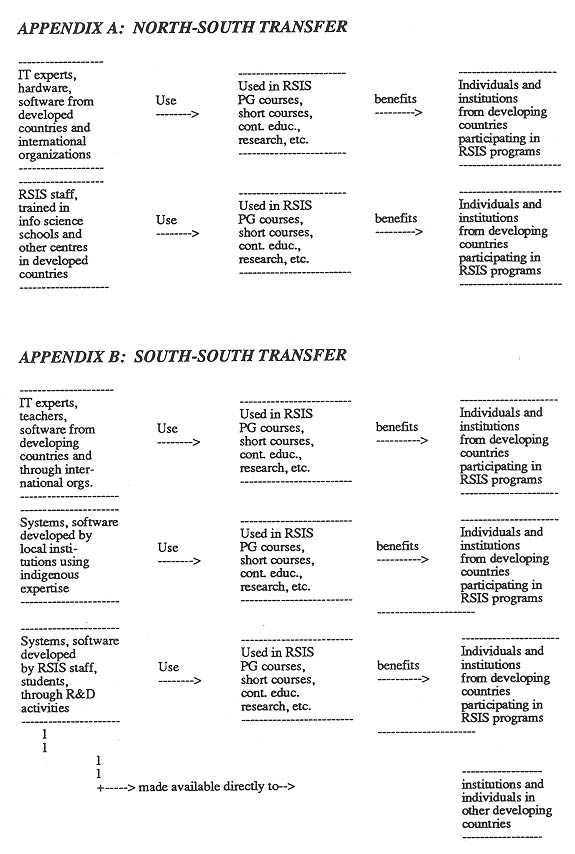
• contributed to the technology transfer process in the information field, from both North to South and South to South. Appendices A and B show the modes of such technology transfer.
• contributed to the enhancement of information science teaching in
the national schools and to the establishment of new schools.
In the African continent, the School of Information Studies for Africa (SISA) at Addis Ababa University, Addis Ababa, Ethiopia, and the African Regional Centre for Information Science at the University of Ibandan, Ibadan, Nigeria, are two important regional 2-year postgraduate programs leading to a Master's de-gree in information science that became operational in the 1990s. These are mainly supported by IDRC, with contributions from UNESCO and bilateral aid agencies such as SAREC, SIDA, and NORAD.
SISA's focus, by mutual arrangement among the schools, has been on IT and is well equipped to meet the needs of the region, of hardware, software, and so on. National and expatriate staff assist in conducting the courses and thesis work.
A noteworthy feature of the composition of the trainees of the SISA postgra-duate program is that about 80% of the Ethiopian candidates are not from library or information centers, but are executive personnel and operatives from EDP, planning, accounting, or other departments and bureau of government ministries and parastatals. After training they do not take jobs in library and information centers, but continue their executive, planning, or other administrative work, assisting in the design, upgrade and/or operation of information systems to sup-port executive, planning, and decision making.
The interaction during training, and subsequently between such trainees and those from library environment, academic, and special libraries, has been bene-ficial to both groups. The curriculum and conduct of courses has been adapted to meet the needs of both groups.
Recently a Consortium of African Information Science Schools has been formed with support and seed funding from IDRC. SISA, ARCIS, the Depart-ment of Library and Information Science of University of Botswana, and EBAD in Rabat, Morocco are founding members. A constitution has been adopted. The goal of the Consortium is to help accelerate the process of socioeconomic deve-lopment by enhancing the capabilities of the region to use information more productively in support of all stages of decision making, cultural enrichment, and the promotion of science and technology.
The Consortium's broad objective is to promote, support, and undertake such programs, projects and activities that are necessary and appropriate for the development of African human resources for positions in the middle and higher management cadres of training, research, and practice in the information sciences and systems. The Consortium's specific objectives are:
• sustaining the programs
• utilizing resources optimally
• strengthening information infrastructures
• promoting regional cooperation and integration
• coordinating development assistance for information science education in Africa.
A secretariat, initially hosted by SISA, has been established to administer the programs and activities of the Consortium. Programs of the Consortium include:
• consultancy and advisory services, eventually using mainly expertise avai-lable in Africa
• continuing education
• enhancement of teaching resources and teaching methods, books produc-tion, nonbook materials, training of trainers
• research, with special focus on the African environment
• staff and student exchanges.
Program-related considerations include:
• funding, such as the determination of appropriate budget-line items, identi-fication of sources of funding, modalities of attracting funds
• communication among members, such as newsletters, e-mail and other computer-mediated messaging, information exchange, reports and other publications, theses and dissertations database
• sustaining and monitoring legal matters.
Q & A_________________
DISCUSSIONS
[A. Neelameghan]
First of all, I would like to thank Dr. Ching-chih Chen for inviting me to parti-cipate in this NIT '94 roundtable meeting. The actual title of my paper is slightly different from what was introduced. I have changed that to "Information Tech-nology and the Development of Regional Schools of Information Studies." I have another paper on information technology policy issues in developing coun-tries.
[Ching-chih Chen]
Thank you very much Prof. Neelameghan. He has had many years of consulting experience with UNESCO, and we are delighted that he can share with us his experience. Are there any questions or comments?
[Marinus Swanepoel]
In South Africa, we have the concept of the barefoot librarian, which operates in the rural areas. Do you have an equivalent to this kind of operation?
[A. Neelameghan]
As part of the training program, we do have this kind of situation as explained and now in other countries with similar environment. What they are doing in terms of the use of technology to reach out to these people, I mean, how barefoot librarians, as you call them, will be able to make use of technology, for example, to prepare materials and transmit them so that they can use them in the rural areas, we do have a program to expose people to this kind of situation.
[M. Wali]
I have a comment drawing experience from the Africa information center envi-ronment. I agree with Dr. Hayes that a regional arrangement is the best approach to development of manpower in those areas. But we at the National Library are the employers of these products, and from our experience in the past, it has not been satisfactory. First of all, the project is heavily dependent on the external assistance from UNESCO, IDRC, and so forth. Once this assistance stops, then, the future of the program is very difficult to determine. Secondly, the program is too academic; it has not taken into account the national capacities of the different information centers and professionals in the country. It has also failed to recog-nize other efforts made by donors such as AAAS, at different locations, so that these efforts can be harmonized and integrated. Finally, there has been no effort to involve government because they have taken it as a university issue, not a national issue, and until recently there has been no board representing the various countries in the region, who will eventually be requested to take over the finan-cial responsibility of the center or support or sponsor students in these courses and programs. So the whole thing has not been satisfactory.
[A. Neelameghan]
Of course, the SISA situation is slightly different because it is the government which has partly provided the necessary funding. That is one thing. Secondly, with the formation of the consortium now, the whole idea is that if the funding agencies like UNESCO and IDRC, when they withdraw, there will still be money available through the consortium. It is a kind of Trust for African information science education, which allows the representatives from the countries of the region sitting together to determine the optimum use of the available fund. Now, the third thing is, of course, as I mentioned, the regional schools are not intended just to supplant the national schools. They supplement the national schools. In some countries, there are no national schools, and these regional schools provide the kind of seed expertise, who will then provide and start the schools in those developing countries. So they are intended to supplement and provide education for training the trainers. One other point, which we do insist, is that each candi-date is expected to prepare a thesis which will examine the specific information problem of his or her own country. Some of them have done excellent work, which they have been able to implement when they go back to develop the sys-tem.
[Ching-chih Chen]
In the interest of time, I am sorry that we shall
have to move on. We shall hold some of the questions until the end of the
session after all the papers in the session have been presented. Our next
speaker is Bob Doyle. Bob, as I said, is responsible for the International
Programs of the American Library Association. And in recent years, ALA
has had a very successful Library Fellows Program with a joint partnership
with USIS. I am very happy that he can share with us some of these exciting
experiences.