LIS 417: Advanced Subject Cataloging and Classification

Contact Information

Instructor: Daniel N. Joudrey
E-mail: joudrey@simmons.edu
Office: P-205B
Phone: (617) 521-2863

Class: Tuesday 1-4pm
Office Hours:Wednesdays 4-5 pm and by appointment


Course Description

This course addresses the theories, principles, and practices of subject cataloging and classification. It covers the application of national standards to the creation of bibliographic records and to the construction of catalogs in libraries and other information environments. It teaches the concepts of subject cataloging including: understanding the various approaches to and pitfalls in determining aboutness; the theoretical foundations, structure, and the application of LCSH in subject cataloging; the application of the policies in the LC Subject Headings Manual; and complex number building in Dewey Decimal Classification and Library of Congress Classification. The course also includes examinations of the history and theoretical foundations of subject cataloging and classification and explores other subject access systems from around the world. May include readings, discussions, presentations, exams, and written exercises.

Prerequisite: LIS 415: Information Organization
Highly Recommended: LIS 532A: Introduction to Cataloging and Classification.

Audience (level, environment/setting): Advanced; all kinds of libraries; those interested in working in cataloging, metadata services, library automation, technical services, and companies providing bibliographic services.

Relevant Student Learning Outcomes:

  • Graduates demonstrate critical thinking in their practice of library, archival and information science (E)
  • Graduates communicate clearly and effectively in a range of formats to a variety of audiences (E)
  • Graduates demonstrate leadership capability in practice and service and in diverse communities (I)

Objectives
  • To become conversant in the concepts and principles of subject determination, vocabulary control, and classification, and to understand the broader context in which these function.
  • To master skills in subject cataloging and classification, including the ability to create original, machine-coded metadata for bibliographic records in a professional context.
  • To acquire the ability to analyze information resources for subject content, to assign LC subject headings, and LC and Dewey classification notation to information resources, and to provide MARC tagging in preparation for online input.
  • To be able to cite authorities, synthesize opinions, and defend work in written and oral form.
  • To become familiar with other subject cataloging systems.

Links

Course Calendar/Assignments

Bibliography


Textbooks

Required:

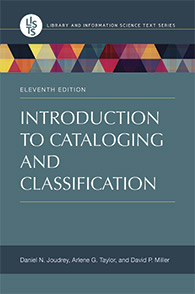
  1. Arlene G. Taylor. Introduction to Cataloging and Classification. 10th ed. Westport, Conn.: Libraries Unlimited, 2006.

Recommended:

  1. Vanda Broughton. Essential Classfication. New York: Neal-Schuman, 2004.
  2. Eric J. Hunter. Classification Made Simple. 3rd ed. Burlington, Vt.: Ashgate, 2009.
  3. Lois Mai Chan. Library of Congress Subject Headings. 4th ed. Westport, Conn.: Libraries Unlimited, 2005.

These titles may be purchased through the Simmons College Bookstore or from online retailers.


Course Outline

Module 1: Subject Access and Aboutness

Module 2: Library of Congress Subject Headings

Module 3: Dewey Decimal Classification

Module 4: Library of Congress Classification

Module 5: Other Subject Access Systems


Structure

The course may consist of any of the following: lecture, discussion, in-class and take-home exercises, lab sessions, readings, paired and/or individual assignments, papers, reviews, quizzes, exams, projects, and presentations.


Expectations and Requirements

Students are expected and required to:

  • attend and be prepared for each class session.
  • read the assigned textbooks and other required materials.
  • complete in-class exercises and homework assignments on time.
  • attend lab sessions.
  • fully participate in group projects and be present for group presentations.
  • turn in assignments representative of graduate-level work.
  • participate fully in group or partnered activities.
  • check your e-mail daily.
  • use the Simmons Libraries Online Catalog, OCLC Connexion, Classification Web, and Cataloger's Desktop.
  • learn to use other cataloging tools.
  • learn to use Moodle and Microsoft PowerPoint software.


Grading Scale


For some assignments, letter grades may be used and for other you will receive grades based on percentages. The following table provides the breakdown of letter grades and percentages.

A - = 90 - 93 %

A = 94 - 100%

B - = 80 - 83 %

B = 84 - 87 %     

B + = 88 - 89 %

C - = 70 - 73 %

C = 74 - 77 %

C + = 78 - 79 % 

D - = 60 - 63 %

D = 64 - 67 %

D + = 68 - 69 %


F= < 60%


Assignments

Due dates for assignments are included in this syllabus. You are encouraged to ask for assistance with assignments when needed. Throughout the term, you will be completing individual assignments as well as working in pairs. All paired assignments are to be done only with your partner. Only one version of the assignment should be submitted from each pair. You may discuss your work on these assignments with each other, but ultimately the work you turn in should be your own (or the work of you and your partner).


Late Policy

All assignments are to be completed and turned in on time. In this class, only hard copies will be accepted (unless there are unusual circumstances). Late assignments will not be accepted. If you do not complete or turn in an assignment on the due date, you will receive a 0 (zero) for that assignment. If you are unable to come to class when an assignment is due, you should email the assignment to the instructor before class begins or send it in with a classmate. There are no extensions, no make-up work, and no exceptions.


Attendance

Class attendance is mandatory, including the first session of the semester. You are expected to be on time (or early), and stay until the end of class for each session. Roll will be taken each week.

Having more than one unexcused absence will negatively affect your participation grade. Students who must miss a class due to religious observance, illness, or other emergency should notify the instructor by e-mail before class time.

Students are responsible for obtaining the class materials distributed during his/her absence. You should plan to get notes, handouts, etc. from your partner or another classmate.


Incompletes

Students who become ill, have a medical emergency, a death in the immediate family, extreme hardship, or unusual circumstances may request an incomplete from the instructor. Students must be performing at a passing level to be considered. Students must work with the Assistant Dean for Student Services in order to request an incomplete.

If approval is granted, the incomplete must be finished before the first week of the following semester (e.g., if you take an incomplete in the spring semester, you must finish the incomplete before the summer term begins). If the incomplete is not finished by the deadline, you will receive a grade based on the assignments that you have completed thus far with zeros entered for the missing assignments.


Academic Integrity

Academic integrity is expected; cheating and plagiarism will not be tolerated. The work you turn in should be your own (or yours and your partner's). If you are referencing the work of others, appropriate citations to that work must be made.

Cases of plagiarism/academic dishonesty will result in zero points for that assignment for all parties involved. There will be no exceptions.

For more information, review the honor code at: http://www.simmons.edu/gslis/resources/honor.php


Special Needs

Reasonable accommodations will be provided for students with documented physical, sensory, systemic, cognitive, learning, and psychiatric disabilities. If you have a disability and anticipate that you will need a reasonable accommodation in this class, it is important that you contact Disability Services at 617-521-2474 early in the semester. They will determine the accommodations needed and create a letter to be given to the instructor. Students with disabilities are also encouraged to contact their instructor to discuss their individual needs for accommodations.


Disclaimer: This syllabus is not a contract. The instructor reserves the right to alter the course requirements, schedule, and/or assignments based on new materials, class discussions, or other legitimate pedagogical objectives. Students will be given notice of relevant changes in class or via e-mail.