AUDIO & VIDEO
When a new technology that can record the human body arrives, it is immediately put in service of representing performers and performance. In 1877, only a generation after the birth of photography, the phonograph entered the scene and gave scientists and entrepreneurs the ability to engrave sound waves on metal plates.1 Such records were called photographies de la voix (voice photographs) by one Frenchman,2 and the very subjects who stood before the photographer’s camera—performers—stood before the phonograph machine, though, unsurprisingly, vocalists were specially valued.3
Less than two decades later, the motion picture appeared, and the performing arts would never be the same. Many early films took their materials from the stage—and not just their stories. Stage stars appeared on what “often appear to be fully equipped Victorian stages,” using the same scenery and property used for live theater.4 For this reason, David Mayer explains, early film provides compelling documentation of Victorian and Edwardian stage practice as much as it demonstrates a new art form emerging.5 Even before the synchronized recording of sound and image was achieved, filmmakers and distributors sought to integrate them through exhibition: Georges Méliès accompanied the release of his adaptation of Faust with a score marked with cues for the pianist, and Pathé released short films of operatic scenes or arias to be projected simultaneously with a phonograph playing the music which the film strip lacked.6 And then, at the end of the 1920s, sound film arrived in the form of Broadway star Al Jolson singing “Toot Toot Tootsie” in The Jazz Singer.
The use of film (either silent or sound) to document a theatrical production—as distinct from simply adapting a play to the screen—is almost as old as the medium itself, with one notable early example being visionary director Max Reinhardt’s transfer of every detail of his 1912 production of The Miracle to a studio in Vienna.7 Most directors and playwrights, however, were initially dubious, viewing film as incapable of mediating the affective charge and unpredictability of live performance.8 This consensus shifted through the growing recognition that motion picture recording was a necessary if flawed tool for research and internal record-keeping.9 The 1970s inaugurated a proactive effort to document theatrical productions, with the Theatre on Film and Tape Collection at the NYPL’s Lincoln Center library beginning its work in 1970,10 and the field of dance saw parallel developments through Jerome Robbins funding the archiving of dance at the New York City Ballet and Dance Theater Workshop initiating a project for documenting downtown and experimental dance.11 That these efforts immediately followed the commercial availability of video recording equipment in the late 1960s is no coincidence. Because video recorders were lightweight, didn’t require much lighting, and could record long stretches of material without needing reels to be frequently replaced, a one-person recording crew could be installed in the house with greater ease than before.12 Unfortunately, after public funding for the arts dried up in the late ‘80s and 90s, companies and theaters had to move documentary efforts in-house, and tight budgets could not always permit their continuance.13
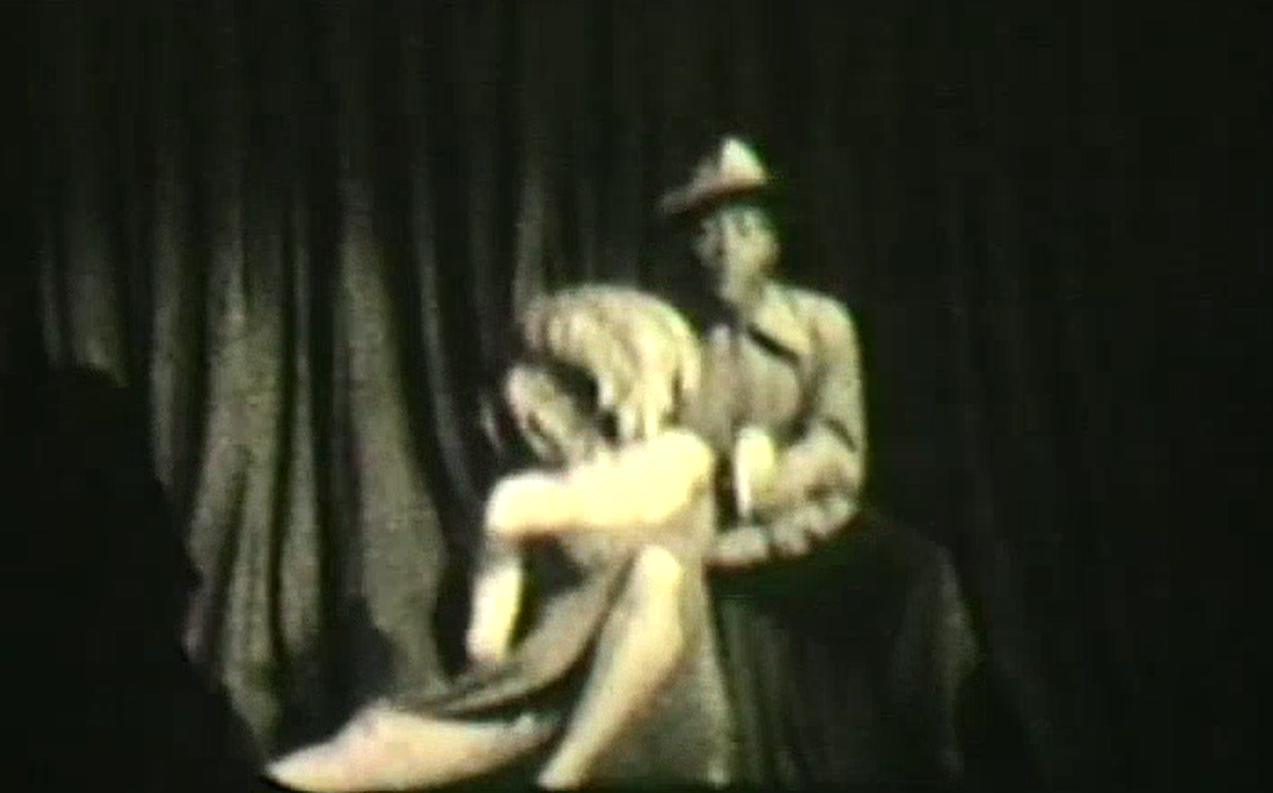
Floyd's Guitar Blues, Katherine Dunham Company, 1956, Katherine Dunham Collection, Library of Congress (no known restrictions)
Dance and performance art have had a more dynamic relationship with the moving image. Due to the lack of standardized notation, film and video make it possible for dances to be reconstructed beyond their creators’ lifetimes, and many of the twentieth century’s most important choreographers—Martha Graham, Georges Balanchine, Maya Deren, Merce Cunningham, Yvonne Rainer and Trisha Brown—have staged dances before the camera.14 The latter four embraced film and video as more than a documentary tool, resulting in works which scholars have variously called “screendance” and “dancefilm.” Cinema’s invention occurred at the same moment that modern dance emerged to break from ballet and explore the “involuntary stream of movement,”15 and dance and cinema’s shared investment in representing movement in time led artists like Deren and Rainer to use cinematography and editing to which represent the moving body in a way that could not be duplicated in theatrical space.16 Performance art, whose inception roughly corresponds with the arrival of video, engaged in a similar exchange with motion picture technology.17 Initially used as a recording device, performance artists came to incorporate the camera and/or video playback into their installations as active agents.18 This practice was especially embraced my feminist artists interested in the political ramifications of the body’s visibility and invisibility.19
In contrast to other performing arts disciplines, the motion picture documentation of opera is, in large part, thanks to television. “Lived and taped transmissions from opera houses were a long-established feature of radio schedules,”20 and given the television industry’s roots in radio, it’s no surprise that this practice should transfer to television. After commercial networks withdrew from investing in studio adaptations of operas, the relay from the opera house became the standard format through which television viewers experienced opera.21 The arrival of consumer video in the 1980s provided another avenue for viewing broadcasts from the opera house,22 and any opera aficionado can tell you how essential VHS and DVD have become to connoisseurship. It is perhaps due to this commercial availability that opera is absent from the collections indexed below.
General/interdisciplinary
Library of Congress
The Library of Congress has many early audio recordings. Go to the audio catalog and then use the faceted browsing menu on the left to refine your results. Restricting by century (and by decade) can be helpful for locating phonograph recordings. Selecting "Recorded Sound Division" or "Johnson Victrola Museum" under the "Part of" facet will also direct you to early recordings. These collections are most pertinent to the study of opera, early Broadway musicals, and minstrelsy rather than spoken drama.
Theater
New York Public Library, Library for the Performing Arts
Theatre on Film and Tape Archive (over 4000 recordings)Victoria & Albert Museum
National Video Archive of Performance, 1992- (approx. 400 recordings)Library of Congress
There is no single record for the Paper Print Collection (ca. 1894-1915), but individual films can be found by going to the Film and Video catalogand navigating to the lefthand navigation, clicking the "More Contributors" facet, and then clicking "Paper Print Collection." 758 items are yielded in the results, with 606 digitized and available online.
Dance
New York Public Library, Library for the Performing Arts
Jerome Robbins Archive of the Recorded Moving Image (723 videos)Merce Cunningham Video Archive, 1960-2008 (742 videos)
National Dance Institute Video Archive, 1980-2010 (541 videos)
Dance on Video Archive (116 videos)
Performance Art & Experimental Theater
New York Public Library, Library for the Performing Arts
PS 122 Video ArchiveBritish Library
Experimental Theatre and Live Art, Sound Archive (approx. 600 recordings)Live Art Development Agency
Live Art Research Collection (over 8,000 items)University of Bristol Theatre Collection
Arts Council England Live Art and Performance Archive (approx. 220 videos)National Review of Live Art archive (139 boxes and 34 TB of digital files, mostly video footage)
[2] Feaster, 70.
[3] Feaster, 71 and 80.
[4] David Mayer, “Learning to see in the dark,” Nineteenth Century Theatre 25:2 (Winter 1997): 112 and 115.
[5] Stephen Johnson substantiates Mayer’s claim by carefully comparing the Library of Congress’s paper print of an 1896 adaptation of Rip Van Winkle with surviving documentation of its theatrical performances in “Evaluating Early Film as Document of Theatre History: The 1896 Footage of Joseph Jefferson’s Rip Van Winkle,” Nineteenth Century Theatre 20:2 (Winter 1992): 101-122.
[6] Marcia J. Citron, Opera on Screen (Yale University Press, 2000), 26.
[7] Annabelle Melzer, “‘Best Betrayal’: The Documentation of performance on Video and Film, Part 1,” New Theatre Quarterly 11:42 (1995): 151.
[8] Melzer, 148.
[9] Melzer, 152-153.
[10] Melzer, 155.
[11] Dennis Diamond, “Archiving Dance on Video: The First Generation,” Envisioning Dance on Film and Video, ed. Judy Mitoma (Routledge, 2002), 118.
[12] Diamond, 119.
[13] Virginia Brooks, “From Méliès to Streaming Video: A Century of Moving Dance Images,” Envisioning Dance on Film and Video, 59.
[14] Brooks, 54-60, and Noël Carroll, “Toward a Definition of Moving-Picture Dance,” Dance Research Journal 33:1 (Summer 2001): 54.
[15] Erin Brannigan, Dancefilm: Choreography and the Moving Image (Oxford University Press, 2011), 34.
[16] Douglas Rosenberg, Screendance: Inscribing the Ephemeral Image (Oxford University Press, 2012), 26.
[17] Johannes Birringer, “Video Art/Performance: A Border Theory,” Performing Arts Journal 13:3 (September 1991): 63.
[18] Birringer, 64.
[19] Barbara Clausen, “Performing the Archive and Exhibiting the Ephemeral,” Histories of Performance Documentation: Museum, Artistic, and Scholarly Practices, eds. Gabrielle Giannachi and Jonah Westerman (Routledge, 2007), 106-107.
[20] Christopher Morris, “Digital Diva: Opera on Video,” The Opera Quarterly 26:1 (Winter 2010): 99.
[21] Citron, 47-48.
[22] Citron, 46.