PLAYBILLS & PROGRAMS
Playbills, the forerunner to the modern program, are the product of a post-printing press world. Advertisements for upcoming performances could feasibly be handwritten, yet the earliest surviving bills date to the late sixteenth century, when printing made it much easier to produce a large number of bills to announce a single day’s performance.1 Early bills were relatively simple, consisting of a title and company or theater name and typically posted on doors and walls,2 but advancements in printing technology allowed formatting to become more elaborate,3 and in London, the rise of “minor theaters” competing with the patent houses of Drury Lane and Covent Garden created the need to capitalize on these advancements. To tantalize potential customers, color could accentuate the title of a blockbuster play, stars’ names were put into bold type, and detailed cast lists placed stars within a constellation of other attractive personages. By the end of the century, the larger bills pasted outdoors were supplemented with smaller handbills sold outside or inside the theatre, where they provided an itinerary for following a performance and from which they could be taken as a souvenir of a night’s out.4
When exactly handbills evolved into the multi-page program is a bit difficult to pin down, as no detailed history of the British program has yet been published. In my own research, forthcoming in an edited collection from the University of Michigan, I date their emergence to the mid-1850s. The standard Victorian format—consisting of a single folded sheet with a design specific to the individual theater on the front cover, the bill of the play on the interior verso and recto, and advertisements and other matter on the back cover—can be found in programs from across the UK by the late 1860s and early ‘70s. Some programs from the period exceeded four pages, with much of the extra space being dedicated to advertisements. Due to these advertisements, programs provide invaluable information about not just casting and repertoire but about who the targeted audience in a given year or location might have been. Some of these audience members even scribbled their impressions in the ample margins surrounding the cast list. In the UK, programs were usually printed on paper of greater sturdiness than the tissue-like handbills, making them easier to write on, collect, and revisit.
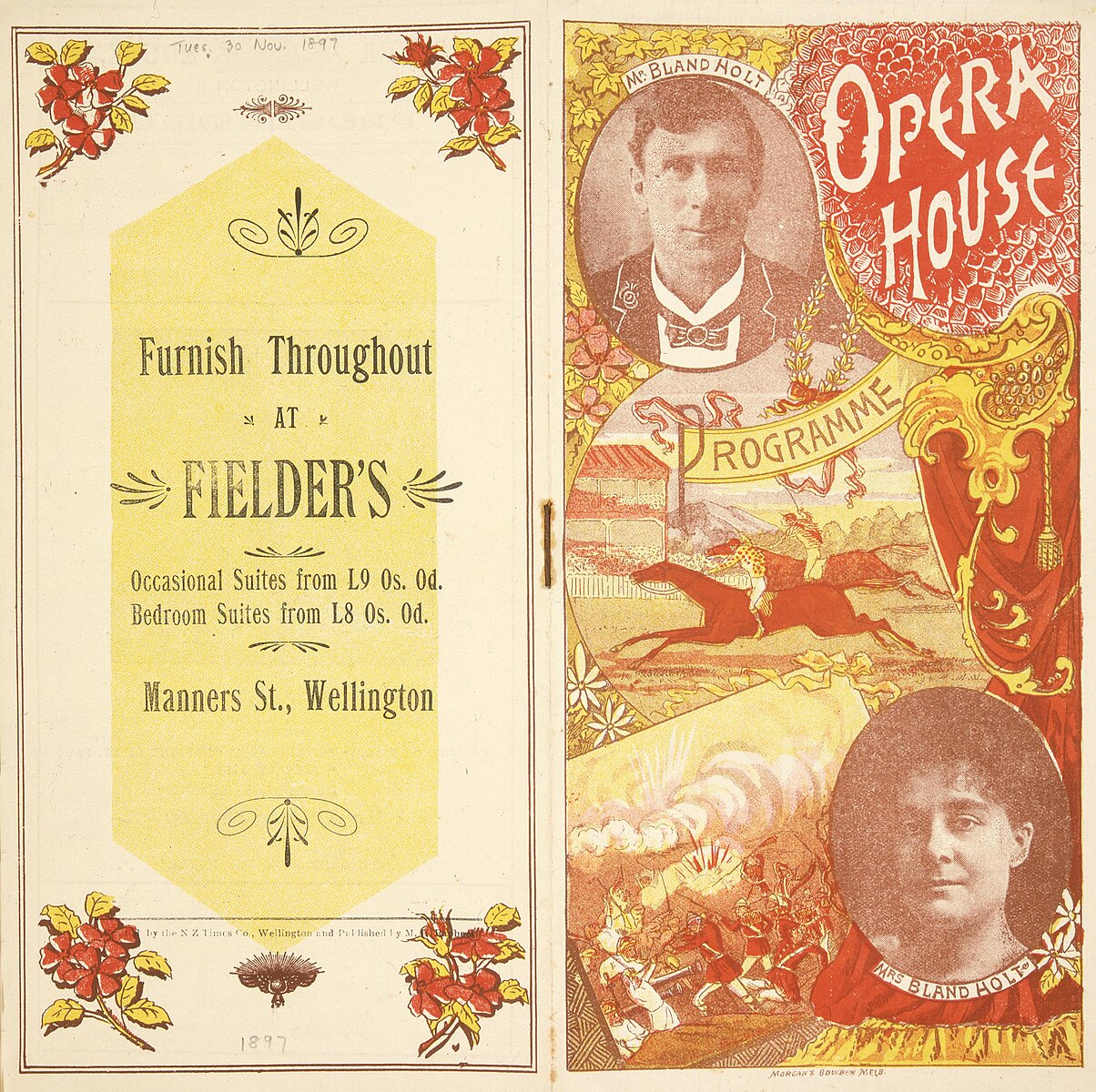
Same format, different hemisphere: Programme for the Opera House, [Wellington], [1897],
National Library of New Zealand (via Wikimedia Commons)
Across the Atlantic, the interdependence between the emergence of the program, the printing industry, and the rise of advertising was even more explicit. Though size and format varied, American printers adopted the “layout, paper, and editorializing style” of newspapers from the 1850s to the end of the century, when Playbill founder Frank Vance Strauss homogenized the format--and eventually monopolized the industry in the US--after years of experimenting with the form.5 As Playbill historian Vicki L. Hoskins lays out, Strauss was first and foremost an advertiser whose initial foray into the business of theatrical ephemera came through placing advertisements.6 Programs became thicker and thicker with ads and editorial content, and by end of World War I, magazine-style programs “of up to twenty pages” began to appear back in the UK.7 Experimentation with design and material continued to occur outside the commercial theatre--hand-drawn fliers spread the word for off-off Broadway performances, and visual artist Robert Rauschenberg even tried his hand at designing the program for a Merce Cunningham residency at an off-Broadway house8--but on Broadway and in the West End, the magazine-style program still reigns supreme.
Theater
New York Public Library, Schomburg Center for Research in Black Culture
Schomburg Programs and Playbills collection, 1845-2022 (146 boxes)Harry Ransom Center, University of Texas at Austin
Playbills and Programs Collection: London and Other United Kingdom Theaters, 1696-2024 (158 boxes) [No published finding aid but container list is available]Playbills and Programs Collection: United States Theaters, 1778-2024 (141 boxes) [No published finding aid but container list is available]
Playbills and Programs Collection: New York City Theaters, 1750-2023 (473 boxes) [No published finding aid but container list is available]
Playbills and Programs Collection: Souvenir Programs and Silk Souvenir Playbills, 1929-ca. 1990 [bulk 1890-1970] (34 boxes) [No published finding aid but container list is available]
Houghton Library, Harvard University
Playbills and programs from London theaters, 1777-1978 (305 boxes, 250 volumes and 56 folders)Harvard Theatre Collection playbills and programs from theatres in Great Britain, 1758-1979 (96 boxes, 167 volumes and 12 folders)
Harvard Theatre Collection of playbills and programs from New York City theaters, ca. 1800-1930 (501 boxes, 790 volumes and 28 oversize folders)
Harvard Theatre collection playbills and programs from Boston theaters, 1775-1988 (272 boxes, 498 volumes and 8 oversize folders)
Harvard Theatre Collection playbills and programs from theaters in the United States, 1800-1900 (145 boxes, 197 volumes and 17 folders)
Harvard Theatre Collection of playbills and programs concerning male "stars," ca. 1700-1930 (46 boxes and 1 folder)
Playbills and programs concerning female "stars," 1767-1962 (20 boxes)
Playbill Inc. Playbill collection, 1924-1985 (18 boxes)
Beinecke Library, Yale University
Souvenir performance program collection, 1840-1950 (9 boxes)Edith Gerber and Gerber/Nottage collection of playbills, 1942-2021 (7 boxes)
Rare Book and Manuscript Library, Columbia University
Program and Playbill Files, Brander Matthews Dramatic Museum Ephemera, 1750-1900 (approx. 41,000 items)Library of Congress
Richard L. Coe Theater Programs Collection: American theatre programs of the twentieth century, 1896-1979 (ca. 5,000 items)British Library
British Library playbills (approx. 80,000 digitized items)Victoria & Albert Museum
London Production Files (52 cubic meters, high proportion of programs)University of Bristol Theatre Collection
Mander & Mitchenson CollectionUniversity of Glasgow Special Collections
Playbills and programmes, Scottish Theatre Archive (approx. 20,000 items)Dance
New York Public Library, Library for the Performing Arts
Dance broadside collection, 1761-1935 (91 folders)Annotated dance performance programs, 1963-1991 (21 boxes)
Joffrey Ballet Company records, 1877-2017 [bulk 1956-2009] (43 boxes of programs)
Harry Ransom Center, University of Texas at Austin
Dance Collection, 1827-1900 [bulk 1910-1960] [No published finding aid; description includes series "Dance Playbills and Programs," extent unknown]Houghton Library, Harvard University
Ballets russes programs, 1907-1929 (4 boxes)Souvenir programs of ballet companies, 1993-2006 (4 boxes)
Souvenir programs of English ballet companies, 1948-1981 (4 boxes)
Library of Congress
Alvin Ailey American Dance Theater collection, 1910-2024 [bulk 1950-2005] (106 boxes of programs)Opera
Harry Ransom Center, University of Texas at Austin
Opera Collection, ca. 1800s-1990 [bulk 1880-1950] [No published finding aid; extent of playbills & programs unknown]Houghton Library, Harvard University
Souvenir programs of operas, operettas, and opera persons, 1902-1986 (2 boxes)Performance Art & Experimental Theater
Fales Library, New York University
Downtown Flyers and Invitations Collection, 1980-1990 (5 boxes)Frank Hentschker Collection of Off and Off-Off Broadway Ephemera, 2004-2009 (1 record carton)
Larry Miller Fluxus Collection, 1976-2011 (1 half MSS box)
[2] Stern, 57.
[3] Gillian Russell, “‘Announcing each day the performances’: Playbills, Ephemerality, and Romantic Period Media/Theater History,” Studies in Romanticism 54:2 (Summer 2015): 246, and Jane Moody, Illegitimate Theatre in London, 1770-1840 (Cambridge University Press, 2007), 154.
[4] Russell, 243 and 246.
[5] Vicki L. Hoskins, "Playbill Takes the Stage: The Rise of America’s Foremost Theatrical Program," PhD diss., University of Pittsburgh, 25.
[6] Hoskins, 23.
[7] Marvin Carlson, “The Development of the American Theatre Program,” The American Stage, eds. Ron Engle and Tice L. Miller (Cambridge University Press, 1993), 103.
[8] Calvin Tomkins, Off the Wall: A Portrait of Robert Rauschenberg (Picador, 2005), 92.