COSTUMES
Theater is an ancient art form, but the use of costumes as an essential element of worldbuilding is, in a European and American context, only a bit over a century year old. With the exception of commedia dell'arte, in which clothing played an important role in distinguishing stock characters, most performers wore some fashionable dress well into the nineteenth century,1 though “antique” costumes would be used for opera and ballet.2 Performers generally had to supply their own wardrobe, and though the Victorian predilection for archaeological realism created a need for taking greater care with costuming, it was actresses who bore the financial brunt of satisfying the public’s desire for period accuracy in historical dramas and magazine-ready trends for contemporary ones.3 Some actresses embraced the chance to play a role in the design process, particularly Ellen Terry, whose relationship with architect Edward William Godwin drew her into the world of Aestheticism populated by Pre-Raphaelite painters and Oscar Wilde.4
To meet the need for elaborate and diverse stage wardrobes,5 some design houses began to specialize in costumerie, but this wasn’t sufficient. As a result of a 1919 strike, actors in New York had to be provided with costumes (including wigs, shoes, and stockings) by the producer.6 The development of set design as a distinct profession soon offered a means of fulfilling this requirement. The assistants working under a designer became specialists in their own right, and by 1936, costume designers were granted entry to the United Scenic Artists union.7 Not every costume created since the 1920s was specially designed for a single actor in a unique production. Stock wardrobes owned by individual institutions and costume shops serving all performing arts institutions in a single locality have become much used resources amid tightened budgets in recent decades, and even those resources face precarity due to financial stress.8
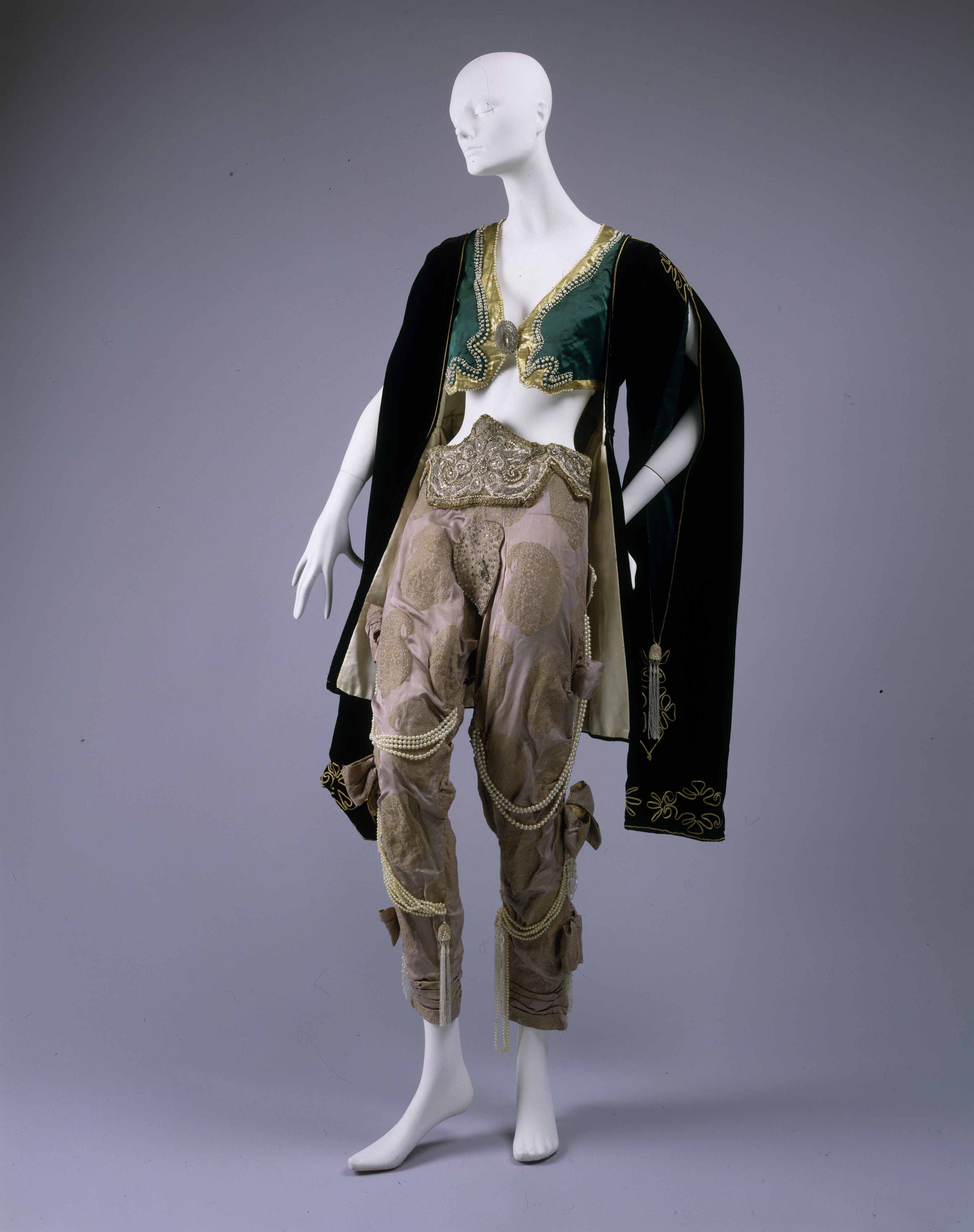
Costume designed by Léon Bakst, 1922-1923, Wikimedia Commons
(image donated and dedicated to public domain by the Metropolitan of Museum of Art)
Like set designers, costume designers often work across performing arts disciplines, and innovations in ballet and opera costuming have paralleled innovations in design for the dramatic stage. For his revolutionary Ballets Russes, Sergei Diaghilev collaborated with studio painters, such as Léon Bakst, whose combination of folk art sensibility and stark European modernism liberated ballet from the paradigm of tights and tutus.9 The gender politics of dance iconography underwent a corresponding shift: female and male bodies became equally ornamental and, in order to better display the body’s movements, exposed.10 Through naked calves and cinched torsos, the latent homoeroticism of Diaghilev’s enterprise became manifest.11 Stage costumes are more likely to be collected by private individuals than libraries,12 where they pose preservation challenges many institutions don't have the resources to address, but the Ballets Russes costumes held by the NYPL and V&A provide a window into a seismic moment in the history of design.
General/interdisciplinary
Victoria & Albert Museum
The online Collections tool contains over 2,000 theater costumes. Select the "Object type" field and type "Theatre costume" in the query box. Most are held at the V&A East Storehouse, which is also where the Theatre & Performance archival collections are stored.
Theater
Harry Ransom Center, University of Texas at Austin
The Costumes & Personal Effects Database includes some costumes. Select "Gordon Conway Papers" or "W.H. Crain Costume and Scenic Design Collection" for theater costumes.
University of Bristol Theatre Collection
The Mander & Mitchen Collection has over 70 costumes, described at the item level. Click on the prior link and select the "plus" button next to "Costumes" in the hierarchy to browse the inventory. There is also a series of props cataloged under "Objects," but they are not yet described at item-level.
Dance
New York Public Library, Library for the Performing Arts
The NYPL has a few dozen dance costumes and ballet slippers,
ranging from costumes for Isadora Duncan and the Ballets Russes from the early twentieth century to the Joffrey Ballet in the late twentieth and early twenty-first
centuries. These materials are not indexed in a single document, but you can go to the main Research Catalog, search for "costume," and limit format to 3-D object.
Harry Ransom Center, University of Texas at Austin
The Dance Collection (1827-1900 [bulk 1910-1960]) includes costumes; go to the Costumes and Personal Effects Database (linked above) and select "Dance Collection."
[2] Friedland and Clancy Steer, 16.
[3] Annie Holt, Modernizing Costume Design, 1820-1920 (Routledge, 2022), 4.
[4] Ellen Terry, The Story of My Life (Hutchinson & Co., 1908), 150 and 305.
[5] Friedland and Clancy Steer, 21.
[6] Ronn Smith, “American Theatre Design Since 1945,” The Cambridge History of American Theatre, Volume III: Post-World War II to the 1990s, eds. Don B. Wilmeth and Christopher Bigsby (Cambridge University Press, 2008), 518.
[7] Smith, 518.
[8] Smith, 524-525.
[9] John E. Bowlt, “Stage Design and the Ballets Russes,” The Journal of Decorative and Propaganda Arts 5 (Summer 1987): 29-31.
[10] Bowlt, 36.
[11] Lynn Garafola, “The Sexual Iconography of the Ballets Russes,” From Russia with Love: Costumes for the Ballets Russes 1909-1933 (National Gallery of Australia, 1998), 61.
[12] The Mander & Mitchenson collection at the University of Bristol was created by two private collectors over the course of several decades. The V&A has thousands of theatre costumes, but they are a museum dedicated to the history of the decorative arts rather than exclusively a library.